Careers··14 min read
Expected CTC answer: what to say when a recruiter asks, how to work out your number, and what CTC really pays in hand
Give a range in lakhs per annum, built from your current fixed pay plus a realistic switch hike, and check what the CTC includes before you agree. Inside: the maths, an ₹18 LPA in-hand breakdown and three sample scripts.

Co-Founder & CTO HiringAnt
Answer "What is your expected CTC?" with a range in lakhs per annum, built from your current fixed pay plus a realistic switch hike, and say what you expect that CTC to include. If you do not yet know the role's level or pay band, ask for it first and give your number after.
Be careful, because CTC (cost to company) is not your salary. It counts money that never reaches your bank account, so two offers with the same CTC can pay very different amounts in hand. Below: what sits inside a CTC, one ₹18 LPA offer worked down to monthly in-hand pay, and scripts for three tricky situations.
Key takeaways
- Work out your number from your current fixed pay, not your current CTC.
- Give a range, and make the bottom of it a number you would genuinely accept.
- In our ₹18 LPA example, about ₹1.09 lakh a month reaches your account under tax year 2026-27 rules: roughly 73% of CTC ÷ 12.
- Never inflate your current CTC. Many employers check payslips before they make an offer.
- When the budget is capped, negotiate what else can move: a joining bonus, a notice buyout, an early salary review.
- Read the CTC breakup in the offer letter line by line before you resign.
What does CTC actually include?
CTC is everything an employer expects to spend on you in a year. A typical Indian offer letter splits it into:
- Fixed pay. Basic salary, house rent allowance (HRA) and other allowances. This is what you are paid every month.
- Variable pay. A performance bonus, usually paid yearly, and only if you and the company hit targets. Treat it as a maybe.
- Employer's PF contribution. Both you and your employer put 12% of your wages into your Provident Fund (Kerala Kaumudi, September 2026). Your share comes out of your monthly pay. The employer's share is counted in your CTC but goes into your PF account, not your hand.
- Gratuity. By law, gratuity is fifteen days' wages for every completed year of service, and a permanent employee qualifies only after five years of continuous service (Code on Social Security, 2020). Fixed-term employees qualify after one year (PIB, November 2025). Many employers still show a yearly gratuity amount inside the CTC.
- Insurance. The premium for group health or term cover. It is a real benefit, but it is not cash.
- One-time items. A joining, relocation or retention bonus. Often repayable if you leave within a set period.
- ESOPs or RSUs. Shares or options that vest over several years. Their value depends on the company's future, so keep them out of any like-for-like comparison.
One recent change matters here. Under the Code on Wages, 2019, if the excluded parts of your pay (such as HRA, conveyance allowance, overtime and commission) come to more than half of your total remuneration, the excess is counted back into "wages" (Code on Wages, 2019). Since PF and gratuity are worked out on wages, many employers are restructuring pay around this rule (Aon, February 2026). In practice, this pushes basic pay towards half of total pay, which is why our example below uses a 50% basic.
Example: a CTC line you should question
"CTC: ₹18,00,000, including target variable pay of ₹1,50,000, employer PF, gratuity and medical insurance."
Ask for the annexure. That one line hides ₹3 lakh you will not receive as monthly salary.
How much of my CTC will I get in hand?
Less than CTC ÷ 12, by more than most people expect. Here is one offer worked through. Every figure is an illustrative assumption, not a benchmark.
The offer: ₹18,00,000 CTC, split as:
| Component | Per year | Per month |
|---|---|---|
| Basic (50% of fixed) | ₹7,50,000 | ₹62,500 |
| HRA and other allowances | ₹7,50,000 | ₹62,500 |
| Fixed pay | ₹15,00,000 | ₹1,25,000 |
| Variable pay (target) | ₹1,50,000 | paid yearly |
| Employer PF (12% of basic) | ₹90,000 | to your PF account |
| Gratuity (assumed provision) | ₹36,000 | paid only if you qualify |
| Group health insurance (assumed premium) | ₹24,000 | not cash |
| CTC | ₹18,00,000 |
Assumptions:
- New tax regime, tax year 2026-27 (FY 2026-27). The slabs are nil up to ₹4 lakh, then 5%, 10%, 15%, 20% and 25% in ₹4 lakh steps, and 30% above ₹24 lakh, plus 4% cess (Finance Bill 2026 memorandum, February 2026).
- A standard deduction of ₹75,000 under the new regime (Income Tax Department, Income-tax Act 2025, section 19).
- PF is paid on your full basic. Some employers cap it at the statutory wage ceiling, which the Union Cabinet raised from ₹15,000 to ₹25,000 a month in September 2026 (Moneylife, September 2026). A cap would raise your in-hand pay and lower your PF savings.
- Professional tax of ₹200 a month. Your state sets it, and the Constitution caps it at ₹2,500 a year (Constitution of India, Article 276).
- No other deductions, and no other income.
The monthly maths:
- Fixed pay: ₹1,25,000
- Minus your PF (12% of ₹62,500): ₹7,500
- Minus professional tax: ₹200
- Minus income tax on fixed pay: ₹8,125. Taxable income is ₹15,00,000 − ₹75,000 = ₹14,25,000, which gives ₹93,750 of tax, or ₹97,500 a year with cess.
- In hand: ₹1,09,175 a month
The ₹1,50,000 variable, if paid in full, falls in the 15% slab, so about ₹1,26,600 reaches you after tax and cess. Add it up and roughly ₹14.4 lakh of the ₹18 lakh CTC arrives as cash in a good year. Another ₹1.8 lakh goes into your PF account, counting both shares.
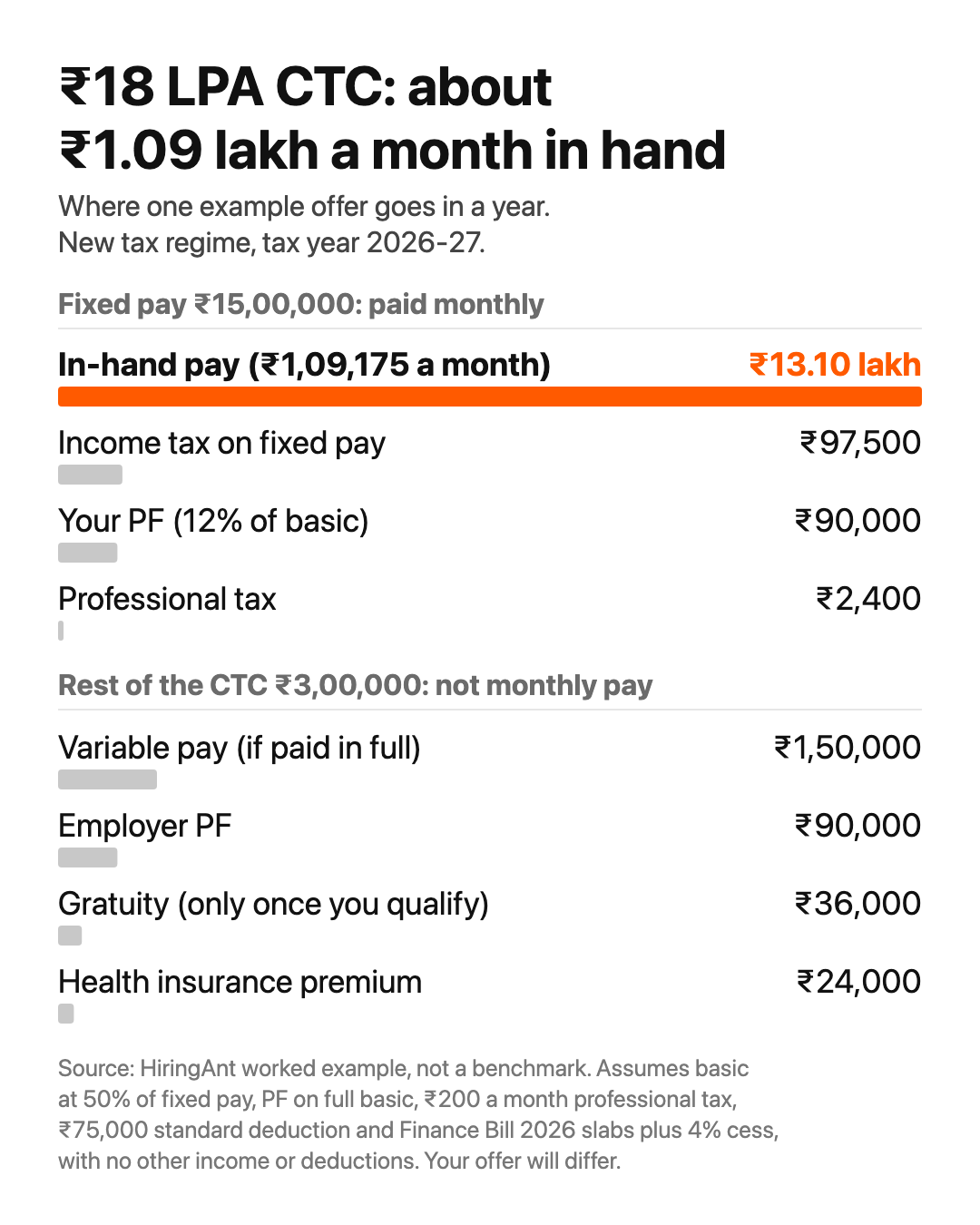
One worked example under the new tax regime for tax year 2026-27. Your own breakup will differ, so run your offer's numbers the same way.
How do I calculate my expected CTC?
Start from what you are paid now, then add a hike you can defend.
- Find your current fixed pay. Take it from your payslip. Leave out unpaid variable, employer PF, gratuity and insurance.
- Check the market. Look at salary ranges on Naukri and LinkedIn posts for the same title, city and experience, and ask people in similar roles.
- Add a switch hike. Annual increments are modest: Aon's survey of more than 1,400 organisations found an average increase of 8.9% in 2025 and projects 9.1% for 2026 (as of February 2026) (Aon, February 2026). People who switch ask for much more. In foundit's 2026 appraisal survey, 70% of professionals said they expect a hike of 21% or more to change jobs, and the most common answer was 21-30% (as of June 2026) (foundit via ThePrint, July 2026). That is what people want, not what they get, so treat it as a sanity check.
- Rebuild a CTC around that fixed pay. Add the variable, PF and benefits the new employer includes, so you compare like with like.
Example: working it out
Current CTC ₹12 lakh, of which fixed pay is ₹10.5 lakh. A 25-30% rise on fixed pay gives ₹13.1-13.7 lakh fixed.
Adding a 10% variable, employer PF, gratuity and insurance on the same pattern as the ₹18 LPA example, that lands at about ₹15.7-16.5 lakh CTC.
Your answer: "I am looking at ₹15.7 to 16.5 lakh CTC, with at least ₹13 lakh of it fixed."
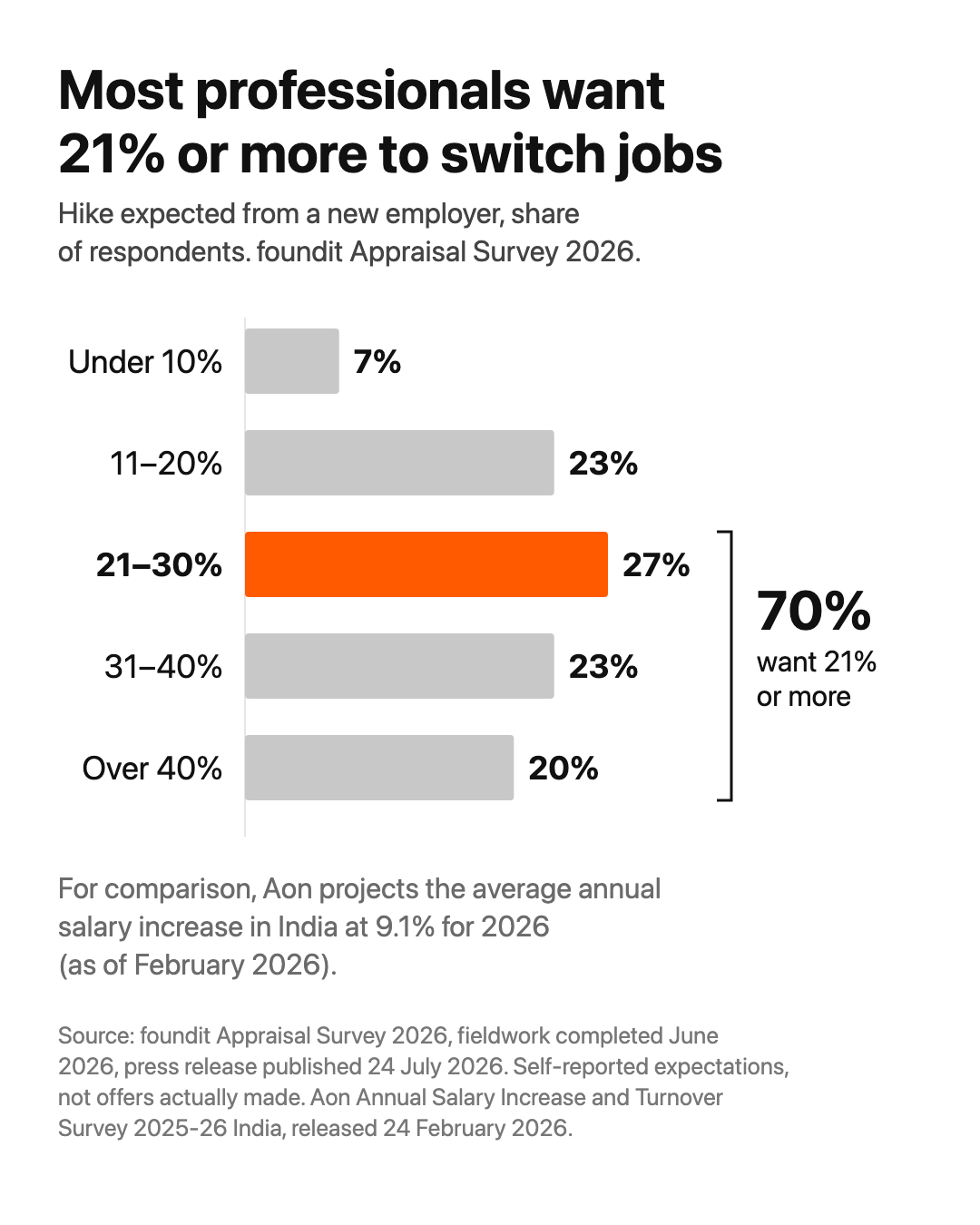
What professionals say they want to switch, not what offers pay. foundit Appraisal Survey 2026, fieldwork completed June 2026.
Should I give a range or an exact number?
Give a narrow range in most cases, about 10% from bottom to top. Make the bottom a number you would accept, because offers often land near it. A range like "₹12 to 20 lakh" says you have not done the maths.
Give a single number when you have a competing offer in hand, or when the recruiter has already shared a band and you know exactly where you fit in it.
If the recruiter has not shared the band, ask before you answer. It is a normal question, and it stops you pricing yourself below the role.
Script 1: an experienced hire on a first recruiter call
"Before I give a number, could you share the band for this role? From what I know so far, I am looking at ₹15.7 to 16.5 lakh CTC, with at least ₹13 lakh fixed. I am flexible on the split once I see the full breakup."
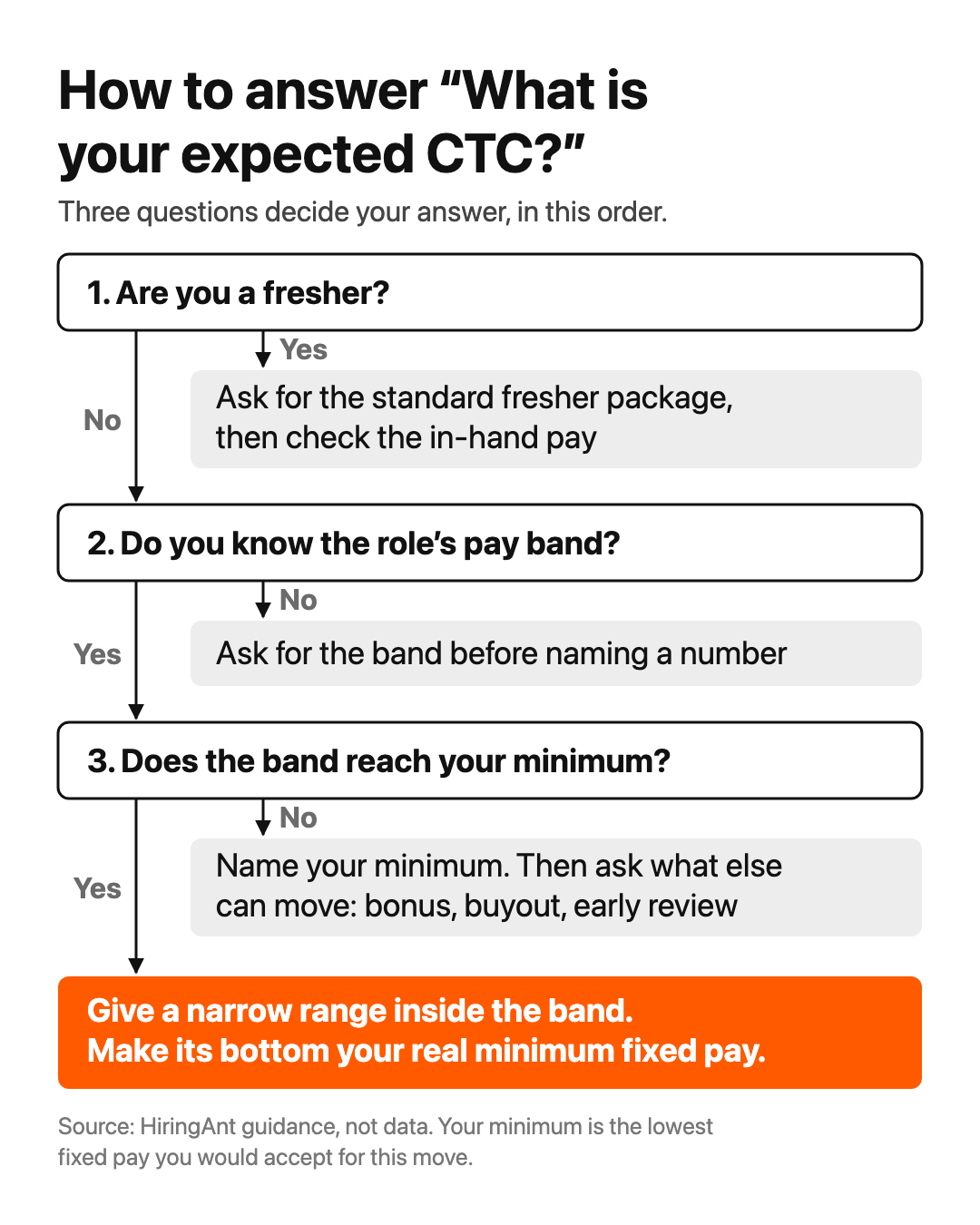
How to choose your answer in the moment. HiringAnt guidance, not data.

How should I answer "What is your current CTC?"
Tell the truth, and give the breakup rather than one number. Many employers ask for recent payslips or Form 16 before they release an offer, and a mismatch can cost you the job even after you have joined.
Split it into fixed, variable and benefits. That shows what you would give up, and stops a recruiter anchoring on money you never received.
Example: current CTC, stated well
"My current CTC is ₹12 lakh: ₹10.5 lakh fixed, a target variable of ₹1 lakh, of which I received about 70% last year, and the rest is employer PF and insurance."
How should a fresher answer expected CTC?
Most freshers are hired into a set package for their role, so the honest answer is that you are open to the company's standard package. Then ask what that package is and how it splits, so you know your in-hand pay.
You have more room in an off-campus or startup role with no fixed band, where your internship or project work is directly relevant. Even then, name a modest range and tie it to that work.
Two more checks at fresher pay levels. Under the new regime, Budget 2025-26 made income up to ₹12 lakh tax-free after the rebate, or ₹12.75 lakh for salaried taxpayers with the standard deduction (PIB, February 2025), so check that the rebate still applies in your tax year. Then read any service agreement or training bond clause, which can cost you more than a small difference in CTC.
Script 2: a fresher in the HR round
"As a fresher, I am open to your standard package for this role. Could you share the CTC and how much of it is fixed? I would also like to understand any service agreement or training bond before I confirm."
What if they say "we can't go above X"?
First, check whether X is below your minimum. If it is above it, you may simply accept, or ask once for a little more on the fixed part.
If X is below your minimum, do not argue against the budget. Ask what else can move. The usual levers are a joining bonus, an earlier salary review, a higher level, or the company paying your notice buyout.
Script 3: the budget is capped
"I understand the fixed budget is ₹12.5 lakh. My minimum for fixed pay is ₹13 lakh, because that is what this move has to cover. Could we close the gap with a one-time joining bonus of ₹1 lakh and a salary review after six months, both written into the offer letter?"
Get every promise in writing. "We will review in six months" said on a call is not part of your offer.
Can I ask the new company to pay my notice period buyout?
Yes, and it is a normal request when they want you early. A buyout is what you pay your current employer for notice days you do not serve, and it works only if your contract or policy allows it or your employer agrees. Our notice period guide explains how buyouts are usually calculated and the other ways to shorten your notice.
Ask the new employer to reimburse the buyout as a joining bonus, written into the offer letter with the amount and the date it will be paid. Check whether that bonus has to be repaid if you leave within a year.
Example message to the recruiter
"To join on 1 December instead of 15 January, I would need to buy out 45 days of notice. Could the company cover that amount as a joining bonus, stated in the offer letter?"
How do I read the CTC breakup in an offer letter?
Ask for the annexure with the full breakup before you resign, and check:
- Fixed pay. Is it at or above the number you asked for?
- Basic pay. Under the wage rule above, expect it near half your pay. A higher basic means more PF and gratuity, and slightly less in hand.
- PF. Is it on your full basic or capped at the wage ceiling?
- Variable pay. Target or guaranteed? What decides the payout, and when?
- Gratuity and insurance. Inside the CTC? Who does the health policy cover?
- Joining bonus. Is there a clawback if you leave within 12 months?
- ESOPs or RSUs. The number of units, the vesting schedule and any cliff before the first vest.
Then run the monthly maths above, and compare offers on in-hand pay, not CTC.
Rehearse the salary conversation
Most people lose money on this question by hesitating or over-explaining. Say your range and scripts out loud until they come out in one breath.
HiringAnt Career Pro includes unlimited AI mock interviews with feedback, with an HR-round style among the interview types, so you can practise the conversation the CTC question usually comes up in. Anyone can try 2 free mock interviews without a plan.
Your expected CTC checklist
- Find your current fixed pay on your payslip.
- Note how much variable pay you actually received last year.
- Look up the role's salary range on Naukri and LinkedIn.
- Decide your minimum fixed pay.
- Turn it into a narrow CTC range.
- Ask for the role's band before you give your number.
- Ask for the offer's full CTC breakup in writing.
- Work out the monthly in-hand pay.
- Check the variable payout terms, the joining bonus clawback and the ESOP vesting.
- Put any buyout reimbursement or review promise into the offer letter.
- Resign only after you have the signed offer letter.
Frequently asked questions
Is CTC the same as gross salary?
No. Gross salary is your fixed pay before deductions. CTC also includes items such as the employer's PF, gratuity, insurance and variable pay. In our example, CTC is ₹18 lakh but gross fixed pay is ₹15 lakh.
How much hike should I ask for when switching jobs in India?
There is no fixed rule. Annual increments average about 9% (Aon, as of February 2026), while 70% in foundit's survey want 21% or more to switch (as of June 2026). Anchor on the role's market range, not only your current pay.
Can I refuse to share my current CTC?
You can decline politely and give your expected range instead, but some employers will insist, and many verify pay with payslips before an offer. If you share it, give the honest breakup.
Should I include my joining bonus in my expected CTC?
No. Keep your expected CTC about recurring pay. A joining bonus is paid once, so ask for it separately, usually to cover a notice buyout or a bonus you lose by leaving.
Sources
- Aon, "Aon Survey Projects Slight Uptick in Salaries in India From 8.9 Percent in 2025 to 9.1 Percent in 2026", 24 February 2026
- foundit, "Appraisal Season: Half of India's Professionals Are Already Job-Hunting", foundit Appraisal Survey 2026, via ThePrint (ANI press release), 24 July 2026
- Ministry of Finance, Memorandum explaining the provisions in the Finance Bill, 2026 (rates for tax year 2026-27), 1 February 2026
- Income Tax Department, Income-tax Act, 2025, section 19 (standard deduction)
- Press Information Bureau, Ministry of Finance, "No income tax on annual income up to Rs. 12 lakh under new tax regime", 1 February 2025
- The Code on Wages, 2019 (Act No. 29 of 2019), section 2(y), India Code
- The Code on Social Security, 2020 (Act No. 36 of 2020), section 53, India Code
- Press Information Bureau, "India's Labour Reforms: Simplification, Security, and Sustainable Growth", 21 November 2025
- Moneylife, "EPFO Wage Ceiling Raised to ₹25,000, to Bring 51 Lakh More Workers under Social Security", 16 September 2026
- Kerala Kaumudi, "EPF wage ceiling raised to Rs 25,000", 16 September 2026
- Legislative Department, The Constitution of India (as on 1 May 2024), Article 276
Avanish Patidar
Co-Founder & CTO HiringAnt
AI engineer, builder, and lifelong learner passionate about turning ambitious ideas into real products. I spend my time building AI agents, voice interviewers, and recruitment systems that help people discover better opportunities and companies hire exceptional talent. Driven by curiosity, innovatio
LinkedIn