Careers··10 min read
Notice period in India: how it works, how to shorten it, and how to time your job switch
If a 60 or 90 day notice period stands between you and your next job, this guide shows where that number comes from, the four ways to shorten it and what each one costs. It also covers what happens if you walk out early, the exit documents to collect, and how to time your search so an offer does not slip away.

Co-Founder & CTO HiringAnt
Your notice period is the time your appointment letter or employment contract says you must keep working after you resign. There is no single national number: one month is common, and IT roles often ask for 90 days. You may be able to shorten it with an early release, a buyout or leftover leave, but only where your contract allows it or your employer agrees.
It matters because recruiters sort candidates by how soon they can join. Here is how to find your number, shorten it, time your search around it, and leave cleanly.

Key takeaways
- Your notice period comes from your appointment letter or contract; there is no single national number.
- A buyout is not a right: it works only where your contract or policy allows it, or your employer agrees.
- An early release backed by a written handover plan costs nothing, so ask for it first.
- Never resign before a written offer, and keep your new employer updated on your last working day.
- Walking out can cost you your relieving letter, part of your final pay and your next offer.
What is a notice period, and where is yours written?
It is the gap between the day you resign and your last working day, when you keep working and getting paid while you hand over. Look for yours here, in this order:
- Your appointment letter or contract. Look for a clause on notice, resignation or termination; some give a shorter period during probation.
- The HR policy it points to. If the letter says "as per company policy", read the resignation, leave and buyout rules on your HR portal.
- Standing orders. Under the Industrial Relations Code, certified standing orders are required only in industrial establishments with 300 or more workers, and "worker" covers supervisory staff only if they earn up to ₹18,000 a month (PIB, 2025).
- Your state's Shops and Establishments Act, depending on your role and workplace.
For most salaried professionals, the contract is what counts. An SCC Online analysis notes that these state laws generally govern non-managerial employees, and that Indian labour law sets no upper limit on the notice an employer can ask for (SCC Online Blog, 2026).
This is general information, not legal advice. Read your own contract, and talk to an employment lawyer if you and your employer disagree about it.
How long are notice periods in India, and is 90 days normal?
A 2022 Analytics India Magazine report found that more than half of jobs in India's organised sector (54.1%) had a notice period of one month or less, almost 1 in every 3 IT roles had 90 days, and almost half of freshers in IT had one month or less (Analytics India Magazine, 2022).
The report does not publish its method or explain why IT runs longer, so treat it as a rough picture. In IT, 90 days is normal enough that it will not shock a recruiter; what they will ask is whether it can come down.
Why do recruiters ask about your notice period?
Because it decides when the work starts. Say two data analysts in Pune clear the same final round on 1 October. One has a 30-day notice and can join in early November; the other, on 90 days, joins in early January. On a short-staffed team, the first has an edge that has nothing to do with the interview.
The gap itself also worries employers. In a Gartner survey of nearly 3,500 candidates, reported by SHRM, half had accepted a job offer in the year to May 2023, backed out and started with another employer (SHRM, 2023). A long notice period is a long window for that.
So answer with a plan, not just a number: "My notice is 90 days; my policy allows a buyout, and I will ask for early release after a 45-day handover." Only say what is true.
How can you reduce your notice period?
There are four routes. None is a right you can insist on; each depends on your contract, your policy or your employer saying yes.
Negotiated early release
Ask your manager to relieve you early, with a written handover plan: what you own, who takes each piece over, and when each item is done. A plan that makes the risk small is easier to approve. This route costs you nothing, so try it first.
Notice period buyout
You pay for the days you do not serve, often by having the amount deducted from your full and final settlement. One common formula is monthly salary ÷ 30 × days not served (Zoho Payroll, 2026), so on ₹50,000 a month, buying out 60 days would cost ₹1,00,000. Check which salary figure your contract uses.
A buyout works only where the contract or rules allow it, or the employer consents (SCC Online Blog, 2026). Get the approved last day and the amount in writing, and if your new employer offers to reimburse it, get that in the offer letter.
Adjusting earned leave
Some employers let you set unused earned leave against your notice, so 15 days of leave turns 90 days into 75. Not every policy allows it, and those days might otherwise be paid out as leave encashment, so do the maths first.
Garden leave
Your employer asks you to stop working for part or all of your notice while you stay employed and paid (TLH, 2020). It is the employer's call, and your last working day does not move.
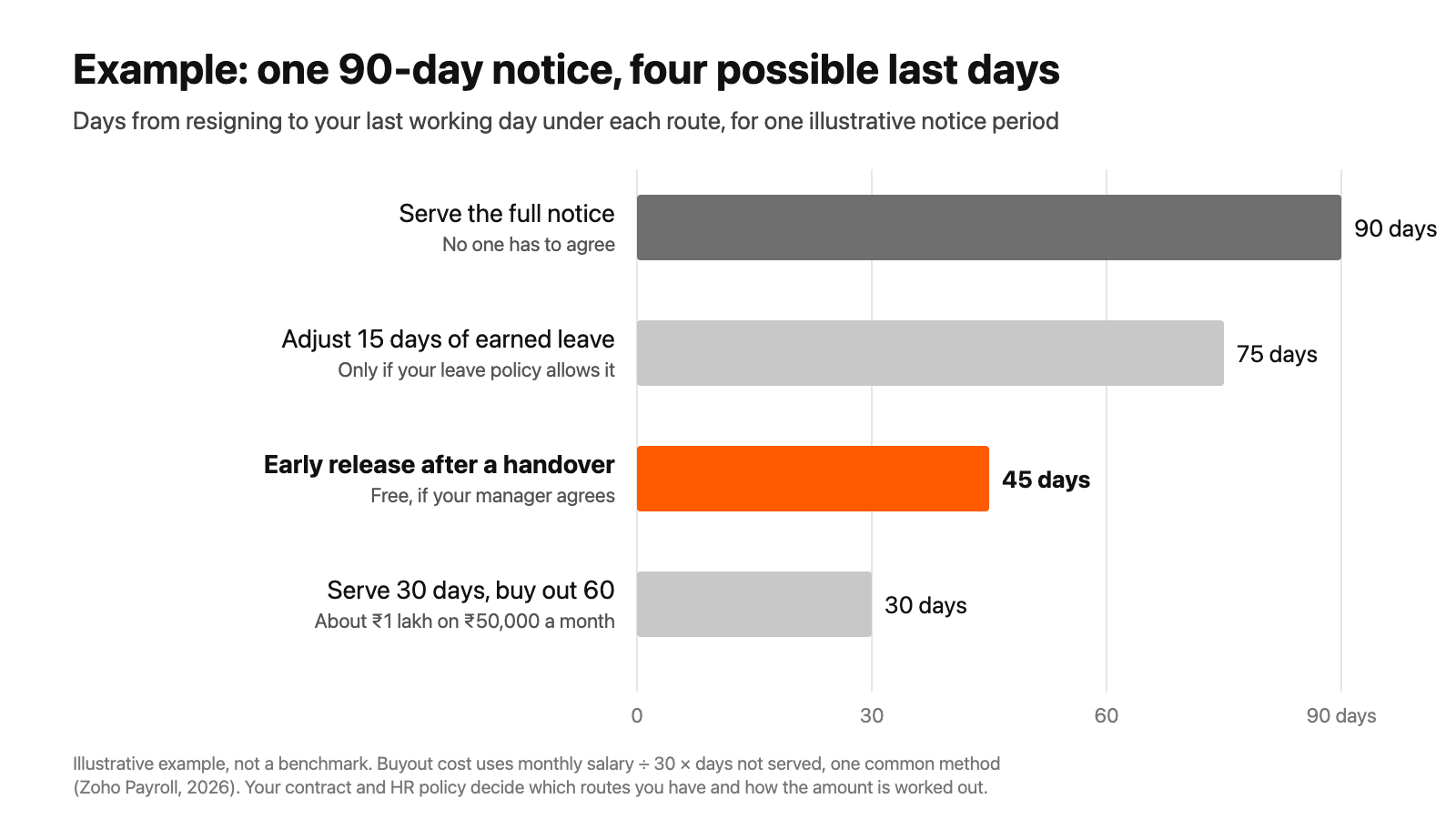
An example, not a benchmark. Which of these routes you actually have depends on your contract and HR policy.
What happens if you leave without serving your notice period?
Walking out, which HR records often call absconding, breaks the terms of your contract, and most of the cost lands on you:
- Notice pay recovery. Your employer can deduct unserved notice pay from your final settlement and pursue legal remedies for its losses (Zoho Payroll, 2026).
- No relieving letter. Without a completed exit you may not get a relieving or experience letter, and your next employer will usually ask for both.
- A failed background check. Verification firms contact your last employer, and an unserved notice can delay your joining or cost you the offer.
How do you time a job switch around a 90-day notice?
Work backwards from your realistic joining date, not forwards from the day you feel like quitting.
- Look before you resign. Rounds and paperwork take weeks, and searching while employed keeps your salary and your bargaining position.
- Resign only after a written offer, with the role, CTC and joining date. A call saying you are selected is not an offer.
- Resign within days of accepting. Every day you wait moves your joining date back.
- Update the new employer in writing as soon as your last working day is confirmed, and whenever it changes.
- Do not collect offers as bargaining chips. Accepting one you never mean to take, just to force a counter-offer, burns a recruiter who will remember you.
The weeks before you resign are where you win back time. AI Job Search reads your resume, searches live job boards and company career pages, and ranks the roles you fit, each with a reason; you can try it free without an account. To keep searching while you work, Career Pro Job Agents run up to 10 saved searches daily or weekly and send email and in-app alerts when a role clears the match score you set.
Before you apply, check that your resume reads cleanly in screening software, and prepare your project stories with the STAR method.
Which documents do you need when you leave?
Collect these by your last working day, and keep digital copies:
- Resignation acceptance: an email confirming your resignation date and last working day.
- Relieving and experience letters: they show you were properly released, and your role and dates. Your new employer will ask for both.
- Full and final settlement statement: final salary, leave encashment and any deductions.
- Payslips and your UAN: keep recent payslips, and use the same UAN at the new job.
Under the Code on Wages, in force since 21 November 2025 (PIB, 2025), wages due to someone who resigns must be paid within two working days of the resignation (Code on Wages, section 17). An HR advisory note says it is unclear whether that covers the whole settlement (AscentHR, 2025), so ask HR for your payout date in writing.
For PF, file an online transfer request (Form 13) if the old balance has not moved; since January 2025, most transfers no longer need employer approval (PIB, 2025).
If you are near five years of service, check gratuity before you fix your last day: for regular employees who resign, it needs at least five years of continuous service (Code on Social Security, section 53).

Your notice period checklist
- Find your notice clause and the HR policy it points to, including buyout and leave rules.
- Work out your earliest realistic last day under each of the four routes.
- Write a one-page handover plan before you resign.
- Start interviewing while employed, and set up job alerts.
- Tell recruiters your notice honestly, and what can come down.
- Resign by email, and only after a written offer.
- Ask for early release first, then a buyout, and get the result in writing.
- Collect your exit documents, confirm your settlement date and transfer your PF.
Frequently asked questions
Can my employer refuse my resignation?
It can hold you to the notice period in your contract, and need not accept a buyout unless your contract or its rules allow one (SCC Online Blog, 2026). Resign by email so the date is on record, and get legal advice if HR will not relieve you once the notice ends.
Can I join a new company during my notice period?
Not before your last working day. Until then you are still employed and bound by your contract, and overlapping employment can surface in background checks. To start sooner, get an early release or buyout agreed in writing.
Can my employer withhold my relieving letter?
Employers usually issue it once you have served or settled your notice and finished exit clearance, such as returning your laptop. If you have done both, ask HR in writing with proof attached, and get legal advice if that fails.
Will my new company pay my notice period buyout?
Some do, especially when they need you sooner. Ask before you accept, and get the amount, payment date and any repayment condition written into the offer letter. A verbal promise is not enough.
Should I mention my notice period on my resume?
It is optional, since job portals and application forms usually ask anyway. If you are already serving notice, one line with your last working day under your contact details helps recruiters looking for early joiners.
Make your notice period work for you
A 90-day notice feels like a wall, but it is mostly a planning problem: line up interviews while employed, get every date in writing, and leave cleanly.
Upload your resume to AI Job Search to see which live roles fit you, read our AI interview preparation guide before the first round, and let Career Pro Job Agents keep searching while you work.
Sources
- Beauty Gupta, SCC Online Blog, "Anomalies Around Notice Period in Employment Contract for Non-Workmen", 2026
- Press Information Bureau, "Industrial Relations Code, 2020: Promoting Harmony and Ease of Doing Business", 2025
- Press Information Bureau, "Government Makes the Four Labour Codes effective to Simplify and Streamline Labour Laws", 2025
- Analytics India Magazine, "Report: Notice Periods in Indian IT", 2022
- Roy Maurer, SHRM, "Survey Finds Half of Candidates Have Accepted a Job Offer Before Reneging", 2023
- Zoho Payroll, "Notice period in India: Meaning, calculation, buyout, and rules", 2026
- Karan Srinivasan, TLH Advocates and Solicitors, "Enforceability of Garden Leave Clause in an Employment Contract", 2020
- Indian Kanoon, "Section 17 in Code on Wages, 2019"
- AscentHR, "2-Day Final Settlement (F&F) Requirement Under the Code on Wages", 2025
- Press Information Bureau, "EPFO Simplifies Transfer Claim Process Through Revamped Form 13 Functionality", 2025
- Indian Kanoon, "Section 53 in Code on Social Security, 2020"
Avanish Patidar
Co-Founder & CTO HiringAnt
AI engineer, builder, and lifelong learner passionate about turning ambitious ideas into real products. I spend my time building AI agents, voice interviewers, and recruitment systems that help people discover better opportunities and companies hire exceptional talent. Driven by curiosity, innovatio
LinkedIn