Careers··9 min read
AI interview preparation: what gets scored, and how to get ready in a week
An AI interview asks job-related questions and rates your answers against the same checklist used for every candidate, so it rewards the preparation any good structured interview does. This guide shows how to tell which kind of AI interview you have, what research found about applicants interviewed by AI, and gives you a one-week plan, a 30-minute setup and a checklist.

Co-Founder & CTO HiringAnt
Prepare for an AI interview the way you would for a good structured interview with a person: know what the role needs, have five or six real stories ready, and practise saying them out loud. Your answers are rated against the same job-related checklist as every other candidate's, and in the setups we know best, a person at the employer reviews the result and decides.
At HiringAnt we build an AI interviewer that employers use for first rounds, so this is written from the other side of the table. Here are the two formats, what is judged, what the research found, a one-week plan and a checklist.

Key takeaways
AI interviews come in two main formats, a recorded one-way video or a live two-way conversation, and the invite tells you which.
Every candidate is rated on the same job-related topics, so specifics and structure matter most.
In a field experiment with about 67,000 applications, applicants interviewed by an AI got slightly more offers, and humans made every decision.
Five or six rehearsed stories, a practice round with follow-ups and a tested microphone do most of the work.
Start early in the window, never in the last hour before the deadline.
What kinds of AI interview could you be sent?
There are two main formats. They reward the same preparation but feel different on the day.
One-way video interview. A question appears on screen and you record your answer. Nobody responds, so each answer has to stand on its own. Clues in the invite: recording your responses, preparation time, or a number of attempts.
Live two-way AI interview. An AI interviewer speaks each question, listens, and asks a follow-up when an answer is thin, so be ready to go one level deeper. Clues in the invite: a conversation, a voice interview, an AI interviewer. Ours is this kind: a short, live voice interview you start whenever you like before the employer's deadline.
Read the invite twice. Note the deadline and anything it says about notes, retakes or what you need on the day, because rules differ between employers.
What does an AI interview actually assess?
A well-built AI interview is a structured interview run by software: every candidate gets the same predetermined questions, and every answer is judged on the same rating scale (US OPM). Employers like the format because structured interviews ranked first at predicting job performance in a 2022 re-analysis of hiring research (Sackett et al., 2022).
The employer picks the topics from the job description. Say you are a fresher applying for customer support in Pune: expect "Tell me about a time a customer was upset with you" and "Are you comfortable with rotational shifts?" A junior data analyst in Bengaluru might get "Walk me through a project where the data was messy."
Expect plain fit questions too. In the field experiment below, the interview guide opened with location, commute and shift flexibility (Jabarian and Henkel, 2026). In India, add notice period and expected CTC; our notice period guide covers both.
The rubric is written around what you say. A story with a situation, your own actions and a result is easy to score well, which is why the STAR method suits AI interviews.
What does research say about candidates interviewed by AI?
If AI interviews make you uneasy, you have company: in a 2025 Gartner survey, only 26% of job candidates trusted AI to evaluate them fairly (Gartner via MediaBrief, 2025).
The most useful evidence for you is a 2025 field experiment by economists Brian Jabarian and Luca Henkel with a recruitment firm hiring entry-level customer service staff in the Philippines. They randomly assigned 67,056 applications to a human recruiter, an AI voice agent using the same interview guide, or a choice between the two. Human recruiters reviewed every interview and made every hiring decision (Jabarian and Henkel, 2026).
Applicants interviewed by the AI were 12% more likely to get an offer, and 18% more likely both to start the job and to still be in it a month later.
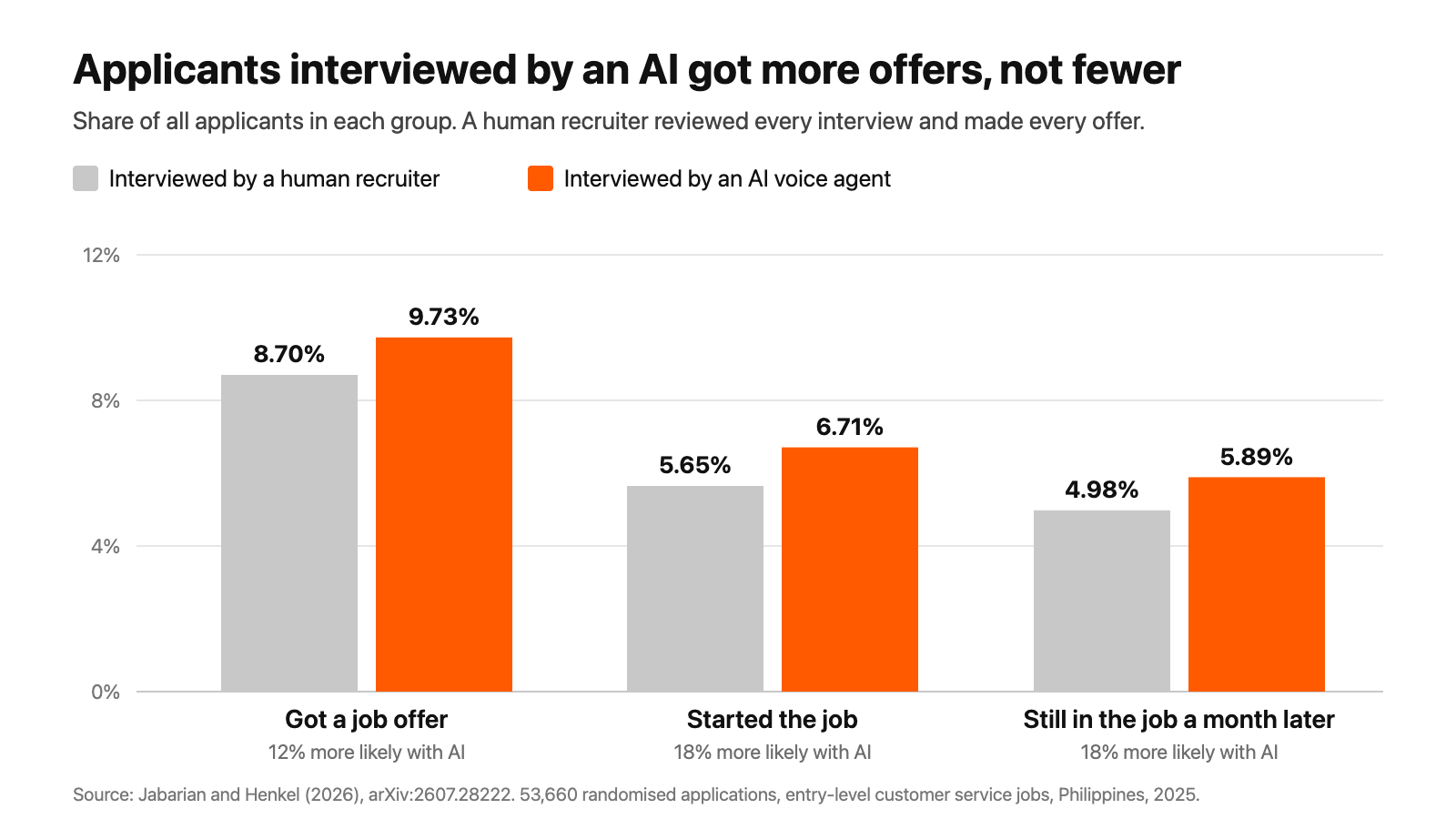
One field experiment, one kind of job. A person made every hiring decision in both groups.
The authors' explanation: the AI followed the interview guide more consistently than the average recruiter and collected more of the information recruiters needed. In plain terms, applicants were more likely to be asked about everything that mattered.
Applicants rated both kinds of interview about the same on stress, comfort and fairness, though the AI felt less natural. Given the choice, 78% picked the AI. And the interview counted: interview scores strongly predicted offers even after test scores were taken into account.
This is one firm, one kind of job and one country, so it does not prove AI interviews are easier everywhere. It does show that the format need not count against you.
How should you prepare in the week before?
A week is enough if you spend it speaking, not just reading.
Day 1: read the job description. Underline the five or six skills it repeats. Those are your likely topics.
Day 2: build a story bank. One real example per topic, as keywords, not a script, with a number wherever you can ("handled 60 chats a shift"). Freshers can use internships, final-year projects, college fests and part-time work.
Days 3 and 4: say it out loud. Record each story on your phone in under two minutes. Listen for filler words and answers that never reach a result.
Day 5: practise with follow-ups. A friend who pushes on the vague bits works, and so do our AI mock interviews, which follow up on what you actually said. Your first two are free; Career Pro makes them unlimited.
Day 6: prepare fit answers. A 60 to 90 second introduction, why this role, notice period, expected CTC, relocation and shifts.
Day 7: test your setup, then rest.
Then start early in the window. Beginning at 11:40 pm on the last day leaves no room for a power cut.
What should you do in the 30 minutes before?
Give the setup half an hour so nothing practical gets between you and your answers, and follow anything the invite asks for.

Quiet room. Shut the door, switch off a noisy cooler, and ask family for half an hour without the doorbell or the pressure cooker.
Power. Start with a full battery and keep the charger plugged in.
Connection. Sit where the signal is strongest and pause downloads on the same Wi-Fi.
Sound. Record ten seconds with your microphone and earphones, then play it back.
Silence. Turn on Do Not Disturb and close other apps.
Light. For video, face a window or lamp, with the camera at eye level.
Last look. Read your story keywords once, drink some water, and open the link ten minutes early.
How should you answer during an AI interview?
Listen to the whole question before you start.
Pause if you need to. Two or three seconds reads as thinking. In a live interview, "Let me think for a moment" is fine.
Keep an order. A line or two of context, what you did, the result, what you learnt. Spend most of your time on what you did.
Say "I", not only "we". The rubric is scoring you.
Be specific. "I built a sheet that flagged overdue invoices, and follow-up time fell from a week to two days" beats "I improved the process."
Tie it to the role. End with why the story matters for this job.
Use the follow-up. It usually means your answer was light on detail, so add detail instead of repeating yourself.
If you don't know, say so, then explain how you would find out.
What happens after the AI interview?
On HiringAnt, the employer's hiring team reviews each interview and decides who moves forward; the AI does not make the hiring decision. The next round is often with a person and goes deeper into the stories you told, so note down the questions you were asked while they are fresh. If a promised decision date passes, one polite follow-up is fine.
What are the most common AI interview mistakes?
Reading a script word for word. It sounds flat and collapses at the first follow-up.
Answering the question you prepared instead of the one you were asked.
Stopping at 15 seconds with no example.
Treating it as a formality. It is scored like any real round.
Your AI interview checklist
Read the invite: format, deadline, and any rules on notes or retakes.
List the five or six skills the job description repeats.
Prepare one real story per skill, each with a number.
Prepare fit answers: introduction, notice period, expected CTC, location.
Say every answer out loud, timed, in under two minutes.
Do one practice round with follow-up questions.
Test your microphone, earphones and connection the day before.
Start early, in a quiet room, with your device charged.
If you are a final-year student, the same list works for campus rounds, and our campus placement guide covers the rest of the drive.
Frequently asked questions
Is an AI interview harder than one with a person?
Not in the field experiment above: applicants rated stress, comfort and fairness about the same, and those interviewed by the AI got slightly more offers. It does feel less natural with nobody nodding back, so practise talking to a screen first.
Can I use notes during an AI interview?
The employer decides, so check the invite and the on-screen instructions. If notes are allowed, keep a few keywords per story; reading full answers sounds flat.
What if my internet drops during the interview?
Rejoin through the same link straight away if it lets you. If it does not, message the recruiter at once with the time and a screenshot of any error, because each employer handles resets its own way.
Can I retake an AI interview?
It depends on the employer and the format. Some one-way video setups let you re-record an answer, but treat your first attempt as the real one, and if something broke, ask the recruiter politely.
How long should each answer be?
One to two minutes for a story question, and 20 to 40 seconds for fit questions like notice period or location. If the screen shows a time limit, finish with a little to spare.
Practise before the one that counts
The quickest way to get comfortable is to sit a few AI interviews before the real one. Career Pro gives you AI mock interviews for your role and round, with feedback on every answer across technical skills, communication, problem solving and confidence, and what to fix. Practice rounds are private: employers never see them.
If you are still looking for roles worth preparing for, AI Job Search ranks live roles against your resume, each with a reason why, and it is free to try without an account.
Sources
Avanish Patidar
Co-Founder & CTO HiringAnt
AI engineer, builder, and lifelong learner passionate about turning ambitious ideas into real products. I spend my time building AI agents, voice interviewers, and recruitment systems that help people discover better opportunities and companies hire exceptional talent. Driven by curiosity, innovatio
LinkedIn