Careers··9 min read
STAR method: how interviewers score your 'Tell me about a time' answers, with examples
In a structured interview, each answer is scored against a scale written before you walk in, and a specific story with your own actions and a result is what reaches the top of it. Here is how that scoring works, the STAR method with timings, weak and strong example answers for freshers, developers, sales and HR, and a story bank you can build this week.

Co-Founder & CTO HiringAnt
If your last interview felt scripted, it may well have been. That helps you: when everyone faces the same questions and scale, a well-built answer beats a confident manner. Below: how scoring works, STAR with timings, four examples and a story bank.

Key takeaways
Structured interviews ask everyone the same questions and score each answer against a scale written in advance.
The top score goes to a specific story with your own actions and a result.
In a STAR answer, spend most of your time on Action and always end with a Result.
Say "I": the interviewer is scoring you, not your team.
Prepare 6 to 8 real stories and practise them out loud.
What is a structured interview, and why do employers use it?
A structured interview gives every candidate for a role the same questions, including planned follow-ups, and scores each answer against a rating scale written in advance (US Office of Personnel Management). Google, for one, says it asks the same questions and grades answers on an identical scale (Google re:Work, 2026).
Employers use it because it works. In a re-analysis of decades of hiring studies, structured interviews predicted job performance best, at .42, against .19 for unstructured interviews and .07 for years of experience (Sackett et al., 2023). The number shows how closely interview scores track later performance.
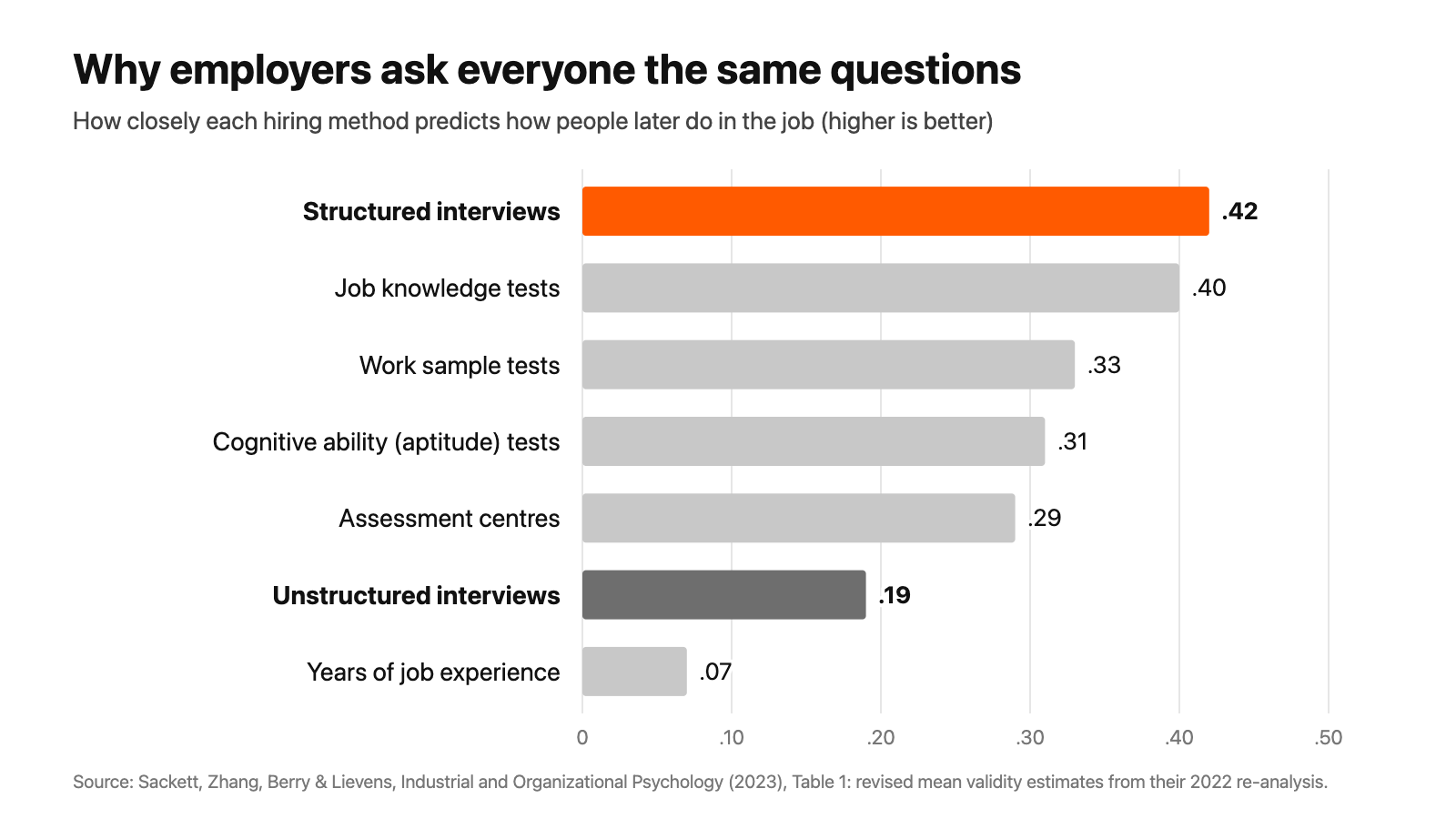
A scripted, scored interview tracks later job performance more than twice as closely as a free-flowing chat.
How do interviewers score your answers?
Each question targets one competency, such as ownership or teamwork. The interviewer notes what you said and picks a score, often 1 to 5, with each level described in writing. Google says it often writes down what a poor, borderline, solid and outstanding answer would cover (Google re:Work, 2026).
An example scale, our illustration rather than any company's real sheet:
Question (ownership): "Tell me about a time something you were responsible for went wrong."
1, weak: No real example. General claims ("I always stay calm"), blaming others, or only what the team did.
3, acceptable: A real example, but thin actions, a vague result ("it got sorted") and nothing changed afterwards.
5, strong: A specific situation, your actions and why, a result with a number, and a step so it would not happen again.
Nothing there about accent, polish or a famous employer. You are scored on what you say, so say every step.
What is the STAR method?
STAR gives that scale what it looks for. The UK's National Careers Service defines the parts as the situation, your task, the action you took, and the result, including what you learned (National Careers Service). For a two-minute answer:
Situation (15 to 20 seconds): where, when, and one number that shows the stakes.
Task (about 10 seconds): what you were responsible for.
Action (60 to 75 seconds): your steps, in order, and why. This decides the score.
Result (15 to 20 seconds): what changed, ideally with a number, and what you learned.
Two rules. Say "I": "we fixed the bug" gives the interviewer nothing to write down. Always land a result: a number, a visible change or, if it went badly, what you now do differently.
STAR method examples: what do weak and strong answers sound like?
The people and numbers below are made up to show the shape; use your own.
Fresher: a teammate who stopped contributing
Question: "Tell me about a time a teammate was not pulling their weight." Say you are a final-year B.Tech student in Pune.
Weak: "One member didn't do his part, so we worked extra and submitted on time. Teamwork is important."
Strong:
S: Four of us were building an attendance app for our final-year project.
T: I owned the Android app. By week three, our backend teammate had pushed no code for ten days, and we could not test.
A: I messaged him privately, not in the group. He was stuck on the server setup and embarrassed to say so. I sat with him for two evenings until the first API worked, then started a 15-minute Sunday team call.
R: We submitted a week early and the demo worked in the viva. I learnt to ask privately before escalating.
Why it scores higher: the weak answer has no action in it. The strong one is mostly action.
Software developer, 3 years: a production issue
Question: "Tell me about a production issue you handled." Say you are a backend developer at a fintech startup in Bengaluru.
Weak: "Our payment service went down once. We checked the logs, found the bug and fixed it."
Strong:
S: One Friday evening, about one in five UPI payments on our app was stuck in 'pending'.
T: I was on call: stop the damage first, find the cause second.
A: That afternoon's release had added a database query with no index. I rolled back instead of hotfixing under pressure, and posted updates every 15 minutes so support could answer customers. On Monday I added the index and a test for it.
R: Stuck payments were back to zero within 20 minutes, and code reviews now include a query check.
Why it scores higher: it shows judgement, communication and prevention, not just an event.
Sales or business development: a missed monthly target
Question: "Tell me about a time you missed a target." Say you sell payroll software to small businesses in Ahmedabad.
Weak: "I missed my March target because the leads were poor. I covered it the next month."
Strong:
S: In March I closed ₹4.2 lakh against a ₹6 lakh target.
T: I had to find out why before April, not just push harder.
A: My CRM showed most deals stalled after the demo: the owner wanted his CA to see it, and I never set up that second meeting. From April I invited the CA to the first demo, with a one-page summary of the GST reports.
R: April closed at ₹6.8 lakh, 113% of target.
Why it scores higher: it owns the miss and finds the cause. Blaming the leads suggests you would miss again.
HR or operations: a process that kept failing
Question: "Tell me about a process you improved." Say you are an HR executive at a 300-person IT services firm in Hyderabad.
Weak: "Onboarding had many issues, so I improved the process and now it runs smoothly."
Strong:
S: New joiners kept arriving with no laptop or email ID. In one quarter, 14 of 40 lost at least a day.
T: Onboarding was mine, so the fix was too.
A: IT only heard about joiners a day or two before they started, so I set up one shared tracker that IT, admin and the hiring manager see from offer acceptance, with an owner for every item.
R: The next quarter, 2 of 38 joiners had a day-one gap.
Why it scores higher: it counts the problem, finds the root cause and fixes the system.
Which mistakes cost the most marks?
A long Situation. Two sentences of scene, then get to your actions.
Answering a past question with "I would...". What you would do is not evidence of what you did.
A memorised script. Follow-ups are planned, and a recited answer falls apart at the first "Why?"
A story that contradicts your resume. Google's guide tells interviewers to use these questions to check resume claims (Google re:Work, 2026). Every number on your resume needs a true story behind it; our ATS-friendly resume guide covers writing those lines.
How do you build a STAR story bank?
Build 6 to 8 real stories, each in four STAR lines, that cover the themes interviews keep returning to. One good story can answer several questions.
Teamwork or conflict: a disagreement or a teammate problem.
Ownership: a mistake you made and fixed.
Problem solving: a problem with no obvious answer.
Pressure: too much work, too little time.
Initiative: something you improved without being asked.
Learning fast: a skill you had to pick up quickly.
Influence: winning over someone you did not manage.
Tag each story with its themes, then check the job description. If it says "stakeholder management" three times, have two stories for it.

How should you practise STAR answers?
Out loud: a story that reads well on paper can run to four minutes spoken. Record each one on your phone, cut anything past two minutes, and listen for "we" and a missing result. Then have a friend interrupt with "What exactly did you do?"
Career Pro goes further: AI mock interviews for your role and round, with an interviewer that follows up on what you actually said. Every answer gets feedback on four skills (technical skills, communication, problem solving and confidence) with what to fix. The free plan includes two mock interviews, and practice rounds are private: employers never see them.
If your first round is an AI interview, STAR works there too; our AI interview preparation guide covers the rest.
Your STAR checklist for this week
Mark the 4 to 6 skills the job description stresses most.
Write 6 to 8 stories in four STAR lines, each with a number or a lesson, and map them to those skills.
Check every story against your resume: dates and numbers must match.
Say each one out loud in under two minutes, record it, and change every "we" that should be "I".
Prepare for two follow-ups per story: "What exactly did you do?" and "What would you change?"
Do one full mock interview and rework your weakest answer.
Frequently asked questions
How long should a STAR answer be?
About two minutes spoken, mostly on your actions. Then stop and let the interviewer ask for more.
What if I have no work experience?
Use college projects, internships, fests, sports, NSS or a part-time job. The National Careers Service says examples can come from work, home or volunteering (National Careers Service). Our campus placement guide covers the rest.
Can I reuse the same story?
Across interviews, yes. Within one interview, avoid repeating a story unless you tell a different part of it.
What if the result was bad?
Say so plainly, then use the Result for what you learned and did differently next time. A real lesson you acted on is a result.
How do I answer 'What would you do if...' questions?
These situational questions describe a scenario from the job (US Office of Personnel Management). Say what you would check first, what you would do and why, and how you would know it worked. If you have faced something similar, add it in one line.
Start with one story tonight
You do not need 30 prepared answers, just 6 to 8 true stories told in STAR order, each ending in a result.
Write the first one tonight, then try it in a free AI mock interview on Career Pro.
Sources
Avanish Patidar
Co-Founder & CTO HiringAnt
AI engineer, builder, and lifelong learner passionate about turning ambitious ideas into real products. I spend my time building AI agents, voice interviewers, and recruitment systems that help people discover better opportunities and companies hire exceptional talent. Driven by curiosity, innovatio
LinkedIn