Careers··11 min read
Campus placement preparation: how drives shortlist students, and how to get picked
Most students leave a campus drive at the eligibility check or the online test, long before anyone interviews them. Here is what the recruiter checks at each stage, a four-week preparation plan, how to handle the technical and HR rounds, and where to look if you are not shortlisted.

Co-Founder & CTO HiringAnt
A campus placement drive runs in a set order: a pre-placement talk, registration, an eligibility check on your marks and backlogs, an online test, sometimes a group discussion, then technical and HR interviews. Most students are cut at the eligibility check and the online test, before any interviewer meets them. So getting shortlisted starts there: know the cut-offs, practise timed aptitude and coding, and bring a one-page resume with two projects you can explain end to end.
Drives are running now. TeamLease EdTech's Career Outlook Report shows fresher hiring intent for July to December 2026 rising to 75% overall, while IT fell to 76% from 81% (The Hans India, 2026). We build the screening and AI interview tools employers use, so here is the other side of the table at each stage, plus a four-week plan.

Key takeaways
Most students leave a campus drive at the eligibility check or the online test, before any interview.
Read your college's placement policy before registering: offer rules and penalties differ.
Spend your first weeks on timed aptitude and coding, where the biggest cut happens.
Two projects you can explain line by line count for more than a long skills list.
Missing the campus shortlist is not the end: apply off campus, or look at paid apprenticeships.
How does a campus placement drive work, stage by stage?
Each company picks from the same stages. Here is what the recruiter checks at each.
Pre-placement talk (PPT): The company explains the role, pay, location and bond. Nobody is scored, but your answer to "why this company" comes from here.
Registration: You sign up for each company, and the placement cell sends your resume to the employer. Register only where you would join.
Eligibility check: A filter on numbers: CGPA or percentage in 10th, 12th and your degree, active backlogs, branch, passing year. You clear the line or you are out.
Online assessment: Aptitude, logical reasoning and verbal ability, plus coding for tech roles or a domain section for others. The recruiter sees a rank, and the shortlist comes from the top.
Group discussion (some companies): Evaluators want a clear point, listening and a summary, not volume.
Technical interview: Your projects, core subjects and how you reason through something new. For B.Com and MBA roles it is often a domain round: accounts, Excel, a case or a sales pitch.
HR interview: Will you join and stay? Expect relocation, shifts, bonds and other offers, and a check that your story matches your resume.
Offer: Usually sent through the placement cell.
Read your college's rules before the first drive. NIT Kurukshetra, for example, runs "one student, one job": campus offers must be accepted, upgrades are allowed only in limited cases, and one unexplained absence from a drive you registered for bars you from all drives for a month (NIT Kurukshetra, 2025). Other colleges use dream-company or tiered rules.
Why do most students get filtered out in the first two rounds?
Because of volume. In 2021-22 alone, India produced 1.07 crore pass-outs, including 8.47 lakh B.E. and B.Tech graduates, 11.08 lakh B.Com graduates and 2.32 lakh MBAs (Ministry of Education, AISHE 2021-22). A company hiring 15 trainees cannot interview 800 students, so it uses its two cheapest filters: a cut-off and a test.
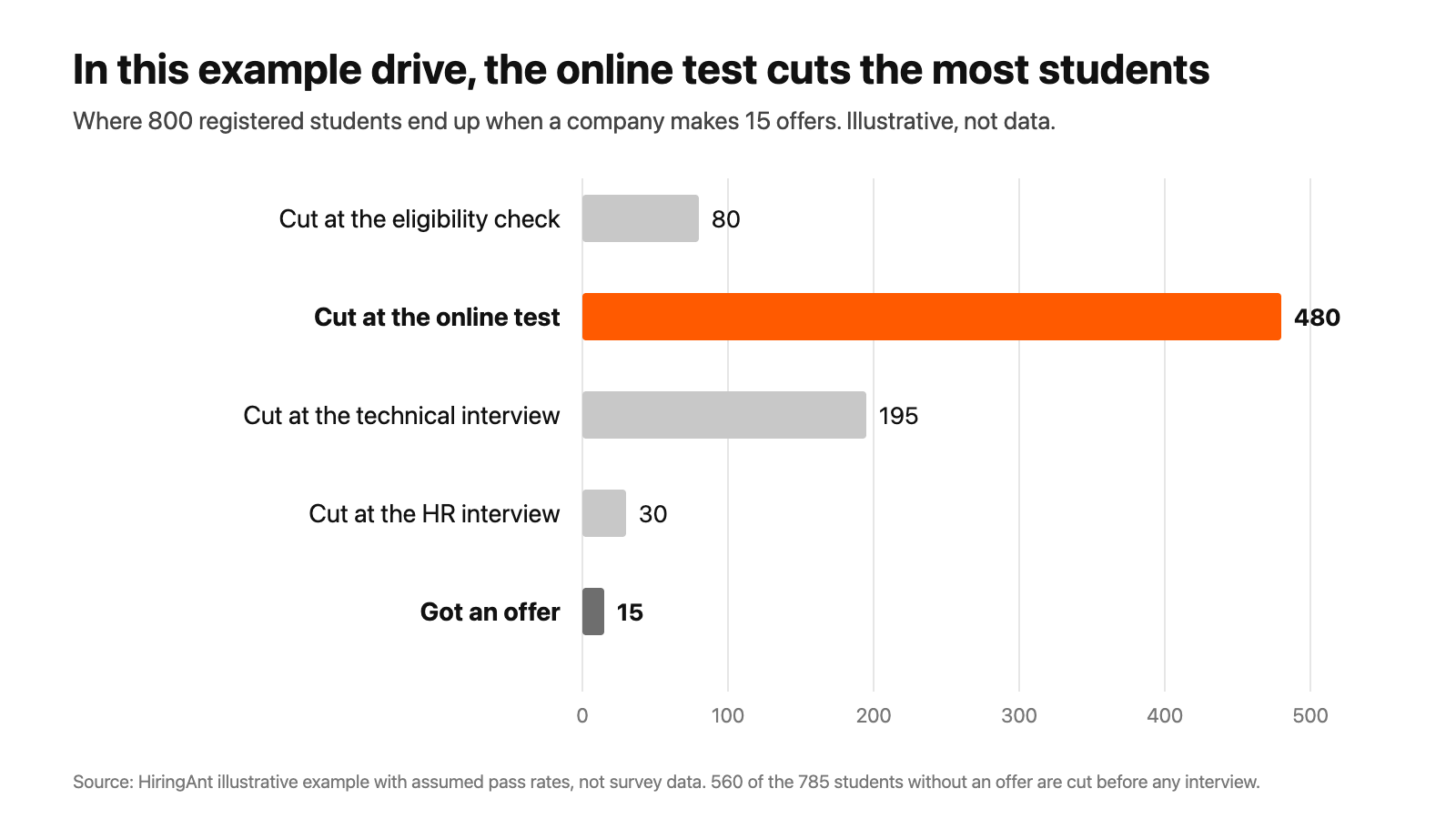
An illustrative example with assumed pass rates, not data.
In this example drive (illustrative, not data), 800 students register, 720 clear eligibility, 240 clear the online test, 45 clear the technical round and 15 get offers. Of the 785 without an offer, 560 never reached an interview. So give the test your first weeks.
Employers also see a real skills gap. The India Skills Report 2026, from the assessment company ETS with CII, AICTE, AIU and Taggd, put employability at 56.35% among the candidates it tested (Deccan Chronicle, 2025), ranging from 80% for computer science engineers and 72.76% for MBAs to 55.55% for arts graduates (Careers360, 2025). That is over 1 lakh people who sat its own test, not a random sample, but the lesson holds: a degree gets you into the test; practice gets you through it.
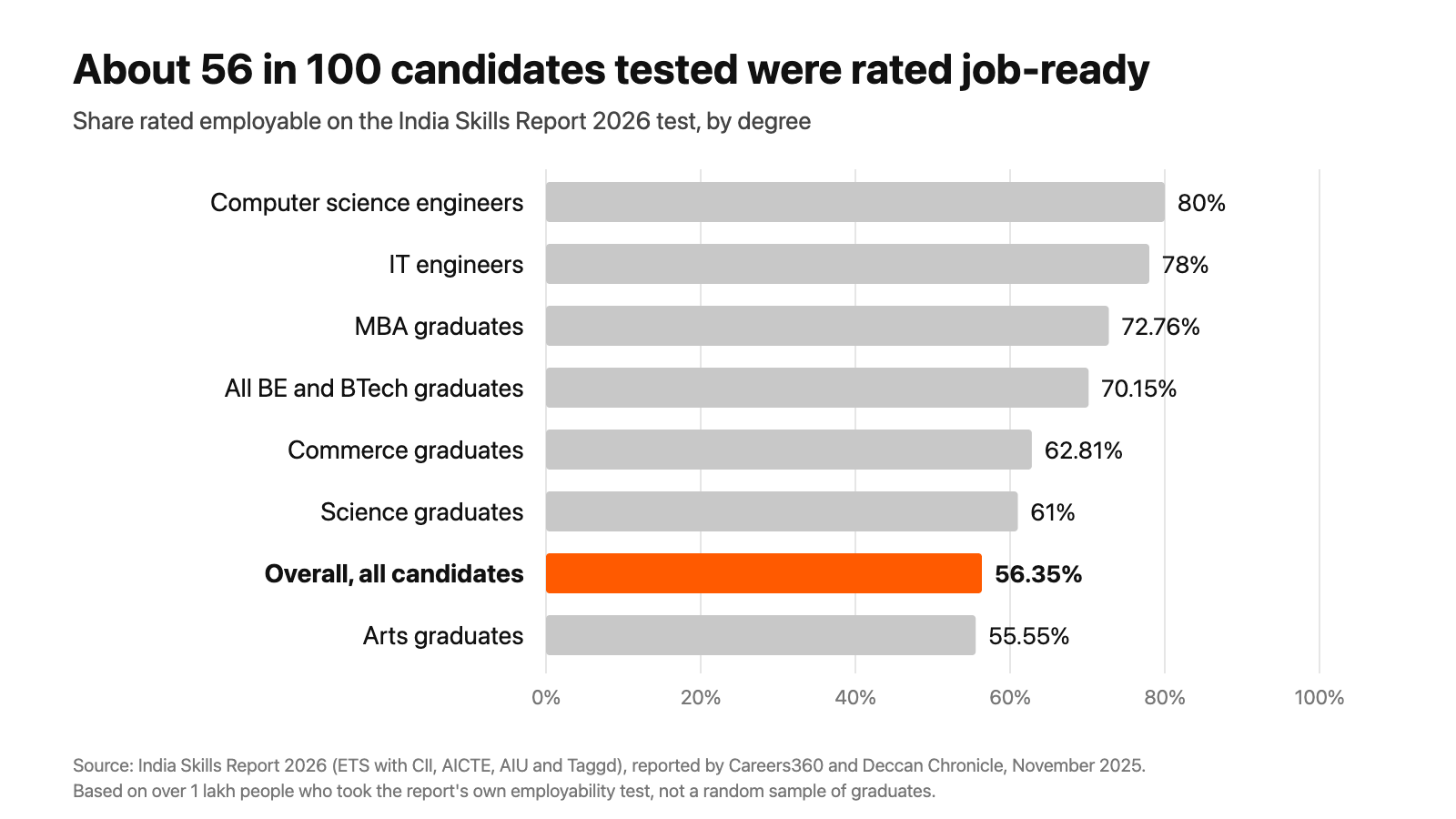
India Skills Report 2026, as reported by Careers360 and Deccan Chronicle.
What should a fresher resume for campus placement include?
From the technical interview on, your resume is the script: interviewers pick a line and ask you to explain it. Keep it to one page and include only what you can defend.
Education: degree, college, CGPA or percentage exactly as on your marksheet, then 12th and 10th.
Skills: only what you can be questioned on. Five you know beat fifteen you have heard of.
Projects: two or three, each with what it does, your part, the tools and one result.
Internships, work and achievements: a six-week internship at a local firm counts; so do a hackathon or keeping the books for a family shop.
"Worked on a library management system" is a weak line. "Built a library app in Java and MySQL with two classmates; I wrote the search and fine modules" hands the interviewer a question you can already answer.
Never stretch the truth: NIT Kurukshetra bars students who put false information on a resume from the next five placement opportunities (NIT Kurukshetra, 2025). For formatting, see our ATS-friendly resume guide; our free resume builder turns an old CV into a one-page PDF, with no sign-up and no watermark.
How do you prepare for campus placements in four weeks?
Plan on two to three focused hours a day, alongside classes.
Week 1, find your gaps: Ask seniors what each company's test covered last year. Take one full timed aptitude test, note your weakest section, finish your resume.
Week 2, aptitude and core subjects: 25 to 30 timed aptitude questions a day, weakest topic first: percentages, ratios, time and work, probability, puzzles, reading comprehension. Tech roles: two coding problems a day on arrays, strings and hashing. B.Com roles: journal entries, GST basics, Excel. MBA roles: your specialisation and business news.
Week 3, projects and speed: Mixed timed sets every other day. Prepare a two-minute explanation of each project: the problem, your part, the hardest bug, what you would change. Revise core subjects (for computer science: DBMS, OOP, operating systems).
Week 4, interviews: Practise answers out loud, not in your head. Run a mock group discussion with friends. Take a full test every two or three days.
For spoken practice, the AI mock interviews in Career Pro ask questions for your role and round, follow up on your answers and give feedback on technical skills, communication, problem solving and confidence. The free plan includes 2; employers never see them.
How do you answer the technical and HR interview questions?
The technical round. Expect to start with your projects, so know every line on your resume. If you do not know an answer, say so and explain how you would work it out; that tells the interviewer more than a guess.
The HR round. Prepare these:
Tell me about yourself: 60 to 90 seconds on your degree, one or two things you have done that fit this role, and why you want it.
Why this company: something specific from the pre-placement talk.
Strengths and weaknesses: a real strength with an example, and a real weakness with what you are doing about it.
Relocation, shifts and bonds: answer honestly; backing out after saying yes can get you in trouble with your placement cell.
For "tell me about a time" questions, use the STAR structure (situation, task, action, result); our guide to STAR method interview answers has examples.
What if the first round is an AI interview?
The India Skills Report 2026 says 70% of IT companies and 50% of BFSI firms have implemented AI in their recruitment (Careers360, 2025). In a campus drive, that can mean a short AI interview before, or instead of, the first technical round.
Usually you get a link and a deadline, take it at a time you choose, and answer role-related questions out loud. On HiringAnt it is a short, live, two-way voice interview, and the employer reviews the results and decides, not the AI. Prepare as for any interview: a quiet room, a tested microphone, specific examples. See our AI interview preparation guide.
Not shortlisted on campus? Where to find off-campus jobs for freshers
Apply early: within a few days of a posting, not at the deadline. Our AI Job Search is free to try without an account: upload your resume and it searches live job boards and company career pages, then ranks the roles you fit, each with a reason. Or browse jobs on HiringAnt.
Apprenticeships: the government's National Apprenticeship Training Scheme (NATS) gives graduates and diploma holders 6 months to a year of paid on-the-job training, with no job guaranteed afterwards (NATS). It engaged 5.23 lakh apprentices in 2025 (PIB, 2026).
Referrals: ask seniors at companies you like to refer you.
Your college's rules: some colleges require a no-objection certificate for certain off-campus offers (NIT Kurukshetra, 2025).

Campus placement checklist: what to do today
Read your college's placement policy: offer rules and the penalty for skipping a drive.
Check your CGPA, percentages and backlogs against recent drive notices.
Cut your resume to one page, with two or three projects you can defend.
Take one timed aptitude test and note your weakest section.
Explain each project out loud in two minutes.
Prepare "tell me about yourself", "why this company", a strength and a weakness.
Start one off-campus search this week.
Frequently asked questions
What CGPA do companies ask for in campus placements?
There is no single number. Each company sets its own floor in the job notification, usually a CGPA or percentage for 10th, 12th and your degree. Below it, you usually cannot sit for that drive, so focus on the drives you clear and on off-campus roles.
Do backlogs affect campus placement?
Active backlogs often do. Companies can make "no active backlogs" a condition, and some colleges, such as NIT Kurukshetra, will not register you with one. Clear them before the season if you can, and never hide one.
How many companies can I sit for in campus placement?
Until your first offer, usually every drive you qualify for. After that, one-student-one-job rules end your season, while dream or tiered rules allow a better-paying company. Register only where you would accept: some colleges make campus offers binding.
What should I do after a rejection in the HR round?
Write down every question while it is fresh and ask your placement officer for feedback. Check the usual weak spots, such as a hesitant answer on relocation or no clear reason for choosing the company, and practise those aloud.
Are off-campus offers worse than campus offers?
Not by default. Judge any offer on the role, the CTC breakup, the bond and the company. Check the company is real, read the offer letter before you sign, and never pay anyone for a job.
Your next step
Pick one checklist item and do it today: a one-page resume in the free resume builder, your 2 free mock interviews in Career Pro, or an AI Job Search run to start applying off campus this week.
Sources
NIT Kurukshetra Training and Placement Cell, "Placement Policy (2025 Batch onwards)", 2025
Ministry of Education, "All India Survey on Higher Education 2021-22", 2024
National Apprenticeship Training Scheme, Ministry of Education, "About NATS", 2026
Press Information Bureau, "National Apprenticeship and Training Schemes", 2026
Avanish Patidar
Co-Founder & CTO HiringAnt
AI engineer, builder, and lifelong learner passionate about turning ambitious ideas into real products. I spend my time building AI agents, voice interviewers, and recruitment systems that help people discover better opportunities and companies hire exceptional talent. Driven by curiosity, innovatio
LinkedIn