Careers··10 min read
ATS-friendly resume format for India: how screening software reads your resume, and what gets you shortlisted
An ATS-friendly resume is one that software can read without losing anything, and one that plainly matches the job description. We build the screening software employers use, so this guide explains what an ATS really does, why the '75% rejected' claim is a myth, and the format, content and India-specific fixes that get a resume shortlisted.

Co-Founder & CTO HiringAnt
An ATS-friendly resume is one that screening software can read without losing anything: one column of real text, standard headings, contact details in the body, saved as a text-based PDF. That gets you read. Content that plainly matches the job description, with evidence, gets you shortlisted.
We build the resume screening software employers use. Here is what happens after you click Apply, why "75% of resumes are rejected by ATS" is a myth, and the format, content and India-specific fixes that work.
Key takeaways
- An ATS is a database that recruiters search, filter and sort.
- The "75% rejected by ATS" claim traces to a 2012 sales pitch with no published method.
- Real filters are set by people: knockout questions and hard criteria such as experience and gaps.
- To parse cleanly: one column, standard headings, no tables, contact details in the body, a text-based PDF.
- To get shortlisted: mirror the job description truthfully and prove each skill with real work and numbers.
What is an ATS, and what happens to your resume inside one?
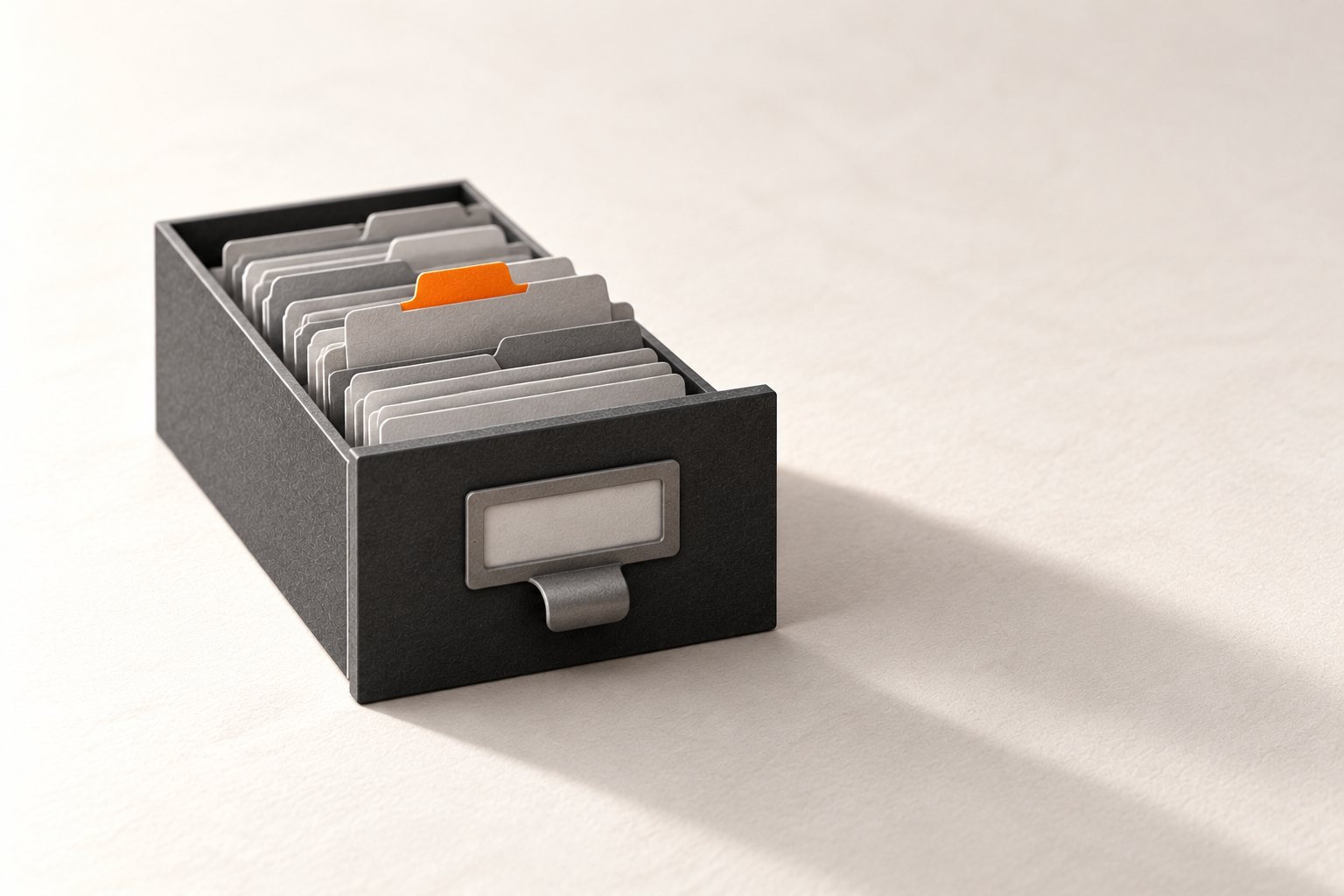
ATS stands for applicant tracking system. A Harvard Business School and Accenture study calls it "a workflow-oriented tool" for tracking applicants through each step of hiring (HBS and Accenture, 2021). Think of a filing cabinet with a search bar.
When you apply, a parser pulls your text into fields: contact details, employers, titles, dates, degrees, skills. The recruiter searches those fields (say, "SQL" and "Power BI" in Pune), filters by your form answers and sorts what is left.
Jobscan checked the careers pages of every Fortune 500 company in 2026 and detected an ATS behind 487 of them, or 97.4% (Jobscan, 2026). We found no reliable count for India. A simple rule: if a careers page takes your resume and fills in a form from it, you are inside one.
Do 75% of resumes really get rejected by an ATS?
No one has shown that. The figure comes from a 2012 sales pitch by Preptel, a resume optimisation company that closed the next year, and no method behind it was published (The Conversation, 2026). HR consultant Christine Assaf, who traced the claim in 2020, concluded that these systems screen and rank applicants while people do the rejecting (HRTact, 2020).
The software still matters. In a survey of 2,275 executives in the US, UK and Germany, more than 90% of employers said they use recruiting software to filter or rank candidates first, and 88% of those using it agreed that qualified graduates get screened out for not matching the exact criteria in the job description (HBS and Accenture, 2021).
So the risk is not a robot that dislikes your font. It is criteria a person typed in, and a resume that does not show you meet them.
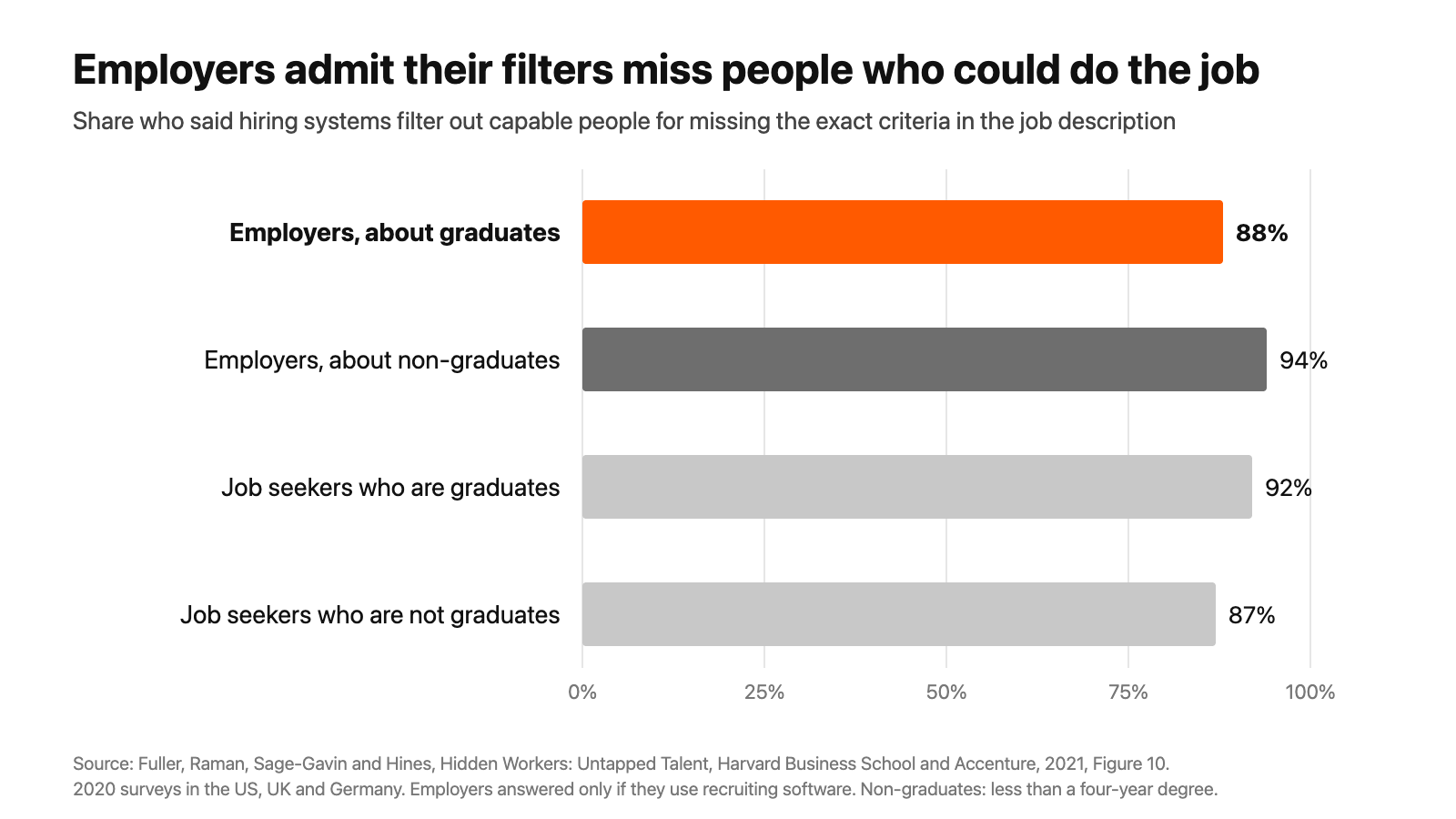
Employers agreed with job seekers: screening misses people who could do the job. Surveys from 2020 in the US, UK and Germany.
What actually gets a resume filtered out?
Four things, and only one is about formatting.
- Knockout questions. Some systems automatically screen on mandatory eligibility questions (The Conversation, 2026). In India: notice period, location, experience, expected CTC, graduation year. Answer honestly, and make your resume agree.
- Hard criteria. In the same survey, 41% to 46% of employers using such software said it filters out graduates on each of work authorisation, credentials, skills, past job titles and employment gaps (HBS and Accenture, 2021).
- An unreadable file. Facts you have, lost because the parser could not read them.
- A person. Whatever survives gets a quick look from a recruiter.
On gaps, the report says almost half the companies surveyed screened out resumes with a gap of more than six months (43% for graduate roles). No resume line beats a date filter, but you can help the human who reads next. If you spent a year on GATE, CAT or UPSC preparation, add one dated line: "Career break, Jun 2024 to Mar 2025: GATE preparation."
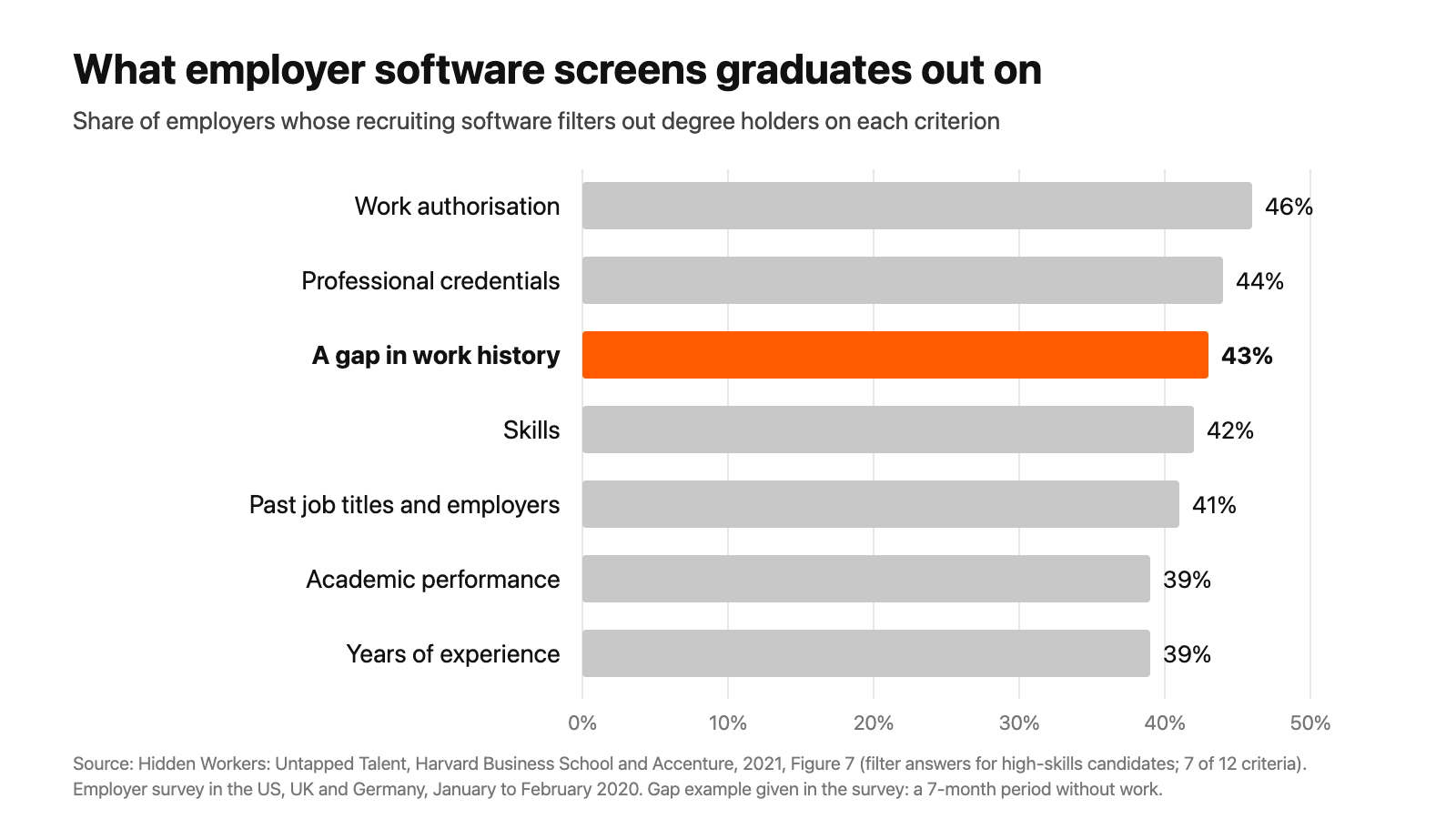
Share of employers whose recruiting software filters out degree holders on each criterion, from a 2020 survey in the US, UK and Germany.
How is AI resume screening different from keyword matching?
Classic ATS search is literal, so "ReactJS" and "React.js" can count as different words. AI screening reads for meaning; HiringAnt's, for example, scores each application against the job description. That changes two things.
- Evidence beats lists. Thirty tools in a skills line are weak; one bullet on what you built with two of them is strong.
- Stuffing backfires. Repeating "Python" ten times adds no evidence, and hidden white text can show up in plain black in the profile a recruiter reads.
On HiringAnt, the employer decides, not the software.
What is the best resume format for an ATS?
Some modern systems read columns and tables; others do not. Greenhouse's help page lists a columned layout, tables, headers and footers, and contact details in a text box among the reasons a resume only partly parses (Greenhouse, 2026). You cannot know which system you will meet, so build for the strictest.
- One column, read top to bottom.
- Standard headings: Summary, Experience, Projects, Education, Skills, Certifications.
- No tables, text boxes, icons, skill bars, graphics or images carrying text.
- Contact details in the body, not in the page header or footer.
- Real, selectable text. Lever cannot parse image files, and its test is whether you can highlight the text with your cursor (Lever, 2026). A scanned resume fails.
- PDF unless DOCX is requested, under 2.5 MB, the largest file Greenhouse can parse.
- Full job titles: "Senior Account Executive", not "Sr. Account Exec" (Greenhouse's own example).
- One date format, month and year, most recent job first.
- A standard font such as Calibri or Arial, 10 to 12 points.
- A sensible file name, such as Priya-Sharma-Data-Analyst.pdf.
Our free resume builder handles most of this: upload your CV, pick a single-column template, and download a PDF with real text, standard headings and contact details in the body.
What should your resume say to get shortlisted?
Format gets you read. Content gets you shortlisted.
- Mirror the job description, truthfully. If it says "stakeholder management" and you did it, use those words. If it wants Power BI and you used Tableau, write Tableau; the interviewer will ask.
- Show skills inside experience. Say you are a fresher applying for a data analyst role in Bengaluru that wants SQL and Power BI. "Skills: SQL, Power BI" is a claim. "Analysed 50,000 rows of sales data in SQL and built a Power BI dashboard of monthly revenue by region (final-year project)" is evidence, with the same keywords.
- Add numbers: team size, tickets closed, rupees saved, hours cut.
- Open with a two-line summary for this role, not a generic objective.
- Keep it short: one page for freshers; two later, if every line earns it.
What should an Indian resume include, and what should it leave out?
Leave out your date of birth, marital status, father's name, religion, caste, full home address, Aadhaar or passport number, and the "Declaration" with a signature. None of it shows whether you can do the job, it eats space on page one, and some of it invites bias.
A photo is optional. Many Indian resumes carry one, but it adds nothing to your assessment, and photos are on Greenhouse's list of parsing problems. If you add one, keep it professional.
Do include:
- Freshers: CGPA or percentage, graduation year, projects, internships and certifications, matching your campus forms. Our campus placement preparation guide explains how those drives shortlist.
- Experienced: current city and a notice period line near the top, such as "Pune, notice period 60 days (negotiable)". Our notice period guide covers buyouts and switching faster.
- Links: LinkedIn, plus GitHub or a portfolio, with titles and dates that match.
Can an ATS score checker tell you if you will be shortlisted?
Partly. A checker can show whether your text extracts cleanly and list job description words your resume lacks. If you have done the thing, say so in your own words.
It cannot see the employer's knockout questions, filters or rival applicants, and no employer sees its score. As two researchers put it, "there is no universal ATS-friendly resume", because employers' software varies so much (The Conversation, 2026). Pasting keywords to chase a perfect score makes the resume worse for its human reader.
A free test: open your PDF, select all, copy and paste into a plain notes app. If it comes out in order with your email and phone intact, a parser will most likely read it too.
To see which real jobs your resume matches, AI Job Search reads it, searches live job boards and company career pages, and ranks the roles you fit, each with a "why you fit". It is free to try without an account.
Your ATS-friendly resume checklist
- Tailor a copy of one master resume for each role you want.
- Use one column and standard headings; no tables, text boxes, icons or skill bars.
- Put your name, +91 phone, email, city and LinkedIn in the body, at the top.
- Run the highlight test and the copy-paste test.
- Save a text-based PDF under 2.5 MB (DOCX if asked) with a sensible file name.
- Write full job titles, one date format, most recent first.
- Put every must-have you genuinely have into a bullet with evidence and a number.
- Delete date of birth, marital status, father's name, religion and the Declaration.
- Explain any gap longer than six months in one dated line.
- Answer knockout questions honestly, and check your resume says the same.
Frequently asked questions
Is PDF or Word better for an ATS?
Either works in most systems if the PDF holds real text, not a scan. Greenhouse, for example, accepts .doc, .docx, .pdf, .rtf and .txt (Greenhouse, 2026). Send a PDF by default and DOCX when the posting asks.
Will a two-column resume get rejected?
Not automatically. Some parsers read columns correctly and others scramble them, which can hide you from a recruiter's search. One column is safer.
How many keywords should my resume have?
There is no magic number. Include every must-have from the job description that you genuinely have, inside a bullet that shows you using it. Repeated or hidden keywords add nothing.
What is the best ATS resume format for freshers?
One page, one column, with education and projects at the top because they are your strongest evidence. Include CGPA, graduation year, internships and project links.
Build a resume that reads cleanly, then see where it fits
Upload your CV to our free resume builder and download a clean PDF: free, no sign-up, no watermark. Then run it through AI Job Search to see which live roles it matches, and why.
When interviews start, our guides to AI interview preparation and the STAR method cover what comes next.
Sources
- Fuller et al., Harvard Business School and Accenture, "Hidden Workers: Untapped Talent", 2021
- Leda Stawnychko and Mehnaz Rafi, The Conversation, "What everyone gets wrong about the modern job search, and what actually works", 2026
- Christine Assaf, HRTact, "Your job application was rejected by a human, not a computer", 2020
- Jobscan, "2026 Applicant Tracking System Usage Report", 2026
- Greenhouse, "Unsuccessful resume parse", 2026
- Greenhouse, "Supported formats for resumes, cover letters and other candidate uploads", 2026
- Lever, "Understanding Resume Parsing", 2026
Avanish Patidar
Co-Founder & CTO HiringAnt
AI engineer, builder, and lifelong learner passionate about turning ambitious ideas into real products. I spend my time building AI agents, voice interviewers, and recruitment systems that help people discover better opportunities and companies hire exceptional talent. Driven by curiosity, innovatio
LinkedIn