Careers··14 min read
Fake job offers on WhatsApp and Telegram: how the task scam works, and a 5-minute check for any offer
A message offers ₹3,000 a day for liking videos, or an offer letter asks for a training or laptop fee. This guide explains how the WhatsApp and Telegram task scam escalates from small payouts to frozen deposits, the other fake job patterns Indian authorities warn about, a 5-minute check for any offer, and exactly what to do, in order, if you have already paid.

Co-Founder & CTO HiringAnt
If a stranger on WhatsApp or Telegram offers you money for liking YouTube videos or rating places on a map, or an "offer letter" asks you to pay for registration, training or a laptop, treat it as a scam. The Reserve Bank of India's fraud-awareness booklet puts it simply: a genuine company offering a job will never ask you for money to give you that job (RBI, BE(A)WARE).
If you have already sent money, call 1930 now, the national cybercrime helpline, then come back to the section "If you have already paid" below. Speed matters more than anything else in this guide.
The rest explains how the task scam escalates, the other fake job patterns that Indian authorities warn about, and a five-minute check you can run on any offer. These schemes are run by organised groups, often from abroad (PIB, 2023). Being taken in by one says nothing about how smart you are.
Key takeaways
- A real employer never charges you to get a job: no registration, training, laptop or "prepaid task" fee.
- In a task scam the first payouts are real. They are bait for the bigger deposits that come next.
- A "tax" or "unlock fee" to release your earnings is the same scam asking for more.
- Never install an app or screen-sharing tool sent in a chat, and never share an OTP, UPI PIN or bank login.
- If you have paid, call 1930 at once, finish the complaint on cybercrime.gov.in, and tell your bank.
How common are fake job offers on WhatsApp?
Common enough that you should expect one. In a LocalCircles survey released in May 2025, 42% of respondents said someone had tried to defraud them or their family on WhatsApp with a job offer, for work from home or other part-time work, that wanted them to pay something. Only lottery and prize messages asking for a "refundable" fee were reported more often, at 45% (LocalCircles, 2025).
Read that number with care. Nearly 11,000 registered LocalCircles members answered the question, they could pick more than one option, and no time period was set. It is not a national rate. It does show how ordinary these messages have become.
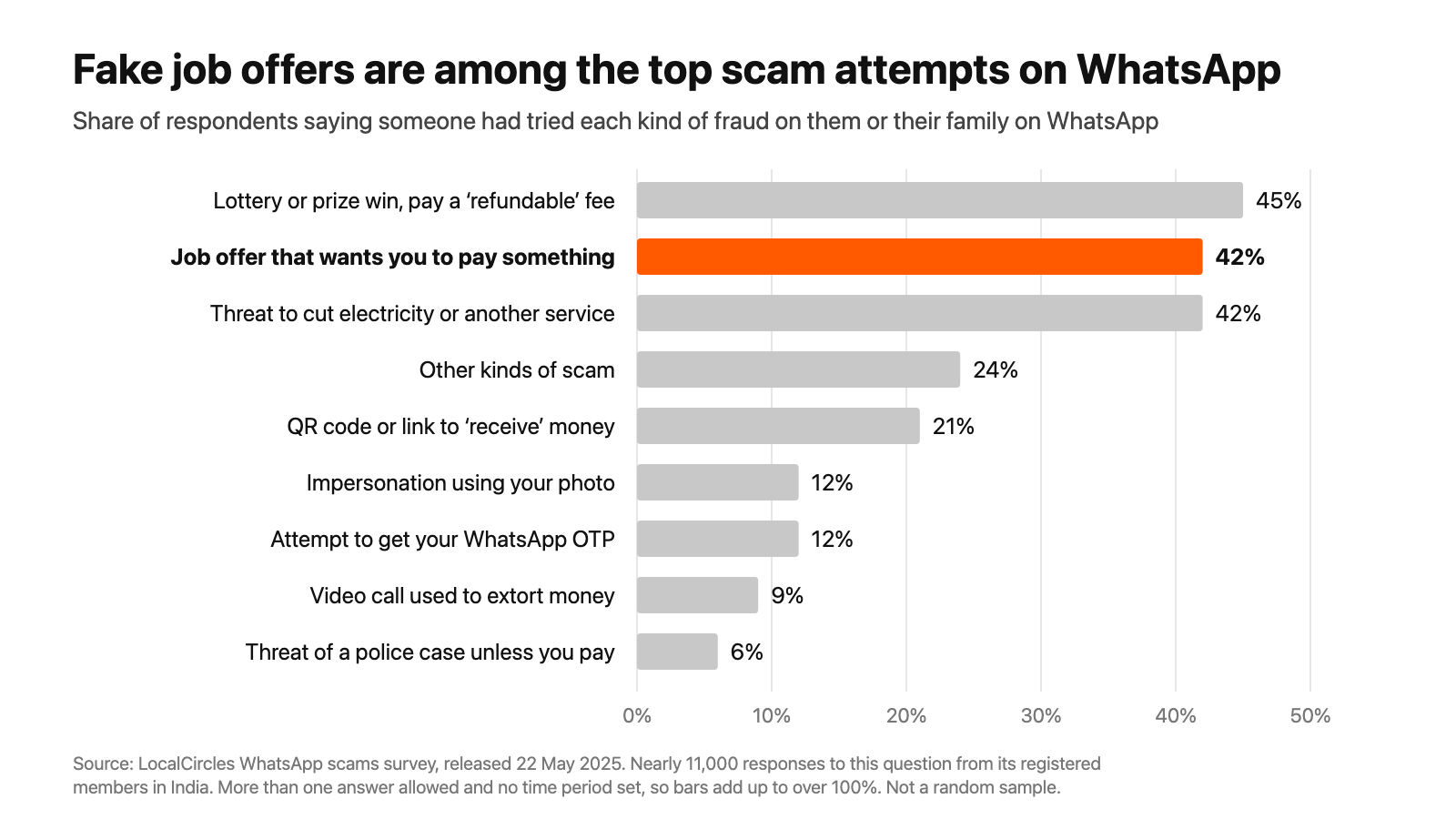
Job offers that ask you to pay are among the most common WhatsApp scam attempts. LocalCircles survey of its members, released May 2025; more than one answer allowed.
The Home Ministry says the people targeted by task-based job frauds are mostly retired employees, women and unemployed youth looking for part-time work. The bait is often a targeted ad using phrases like "Ghar baithe job", run on platforms such as Google and Meta (PIB, 2023).
How does the task scam work, step by step?
In December 2023 the Ministry of Home Affairs described the pattern after more than 100 websites behind task-based part-time job frauds were blocked on the recommendation of the Indian Cybercrime Coordination Centre (I4C) (PIB, 2023). An Enforcement Directorate (ED) investigation in 2025 found the same sequence (ED, 2025). Real cases skip or repeat steps, but the shape is the same.
- The hook. An ad or message leads you to a WhatsApp or Telegram chat with an "agent", who offers simple paid tasks such as liking and subscribing to videos or rating places on maps.
- Small, real payouts. Your first few tasks earn a small commission, paid into your bank account. This is what makes it feel genuine.
- A group, an app and a wallet. You are asked to register on a website or app, sometimes with an OTP, and added to WhatsApp or Telegram groups. The app shows a dashboard of your "earnings" (I4C, 2021).
- "Prepaid" tasks. To get the next tasks, you must first deposit money into the app wallet, usually by UPI to an account the agent gives you, with a promise of bigger returns. This is where it stops being a job.
- Bigger deposits, then a freeze. Each round asks for more. Once you have put in a large sum, your deposits are frozen and withdrawals fail. In the ED case, victims were also pushed to recruit new members for higher commissions.
- The "tax" to release your money. When you ask for your money, you are told to pay tax, processing charges or a membership upgrade first (I4C, 2025). Paying releases nothing. Eventually the app crashes, the website goes dead and the agents vanish.
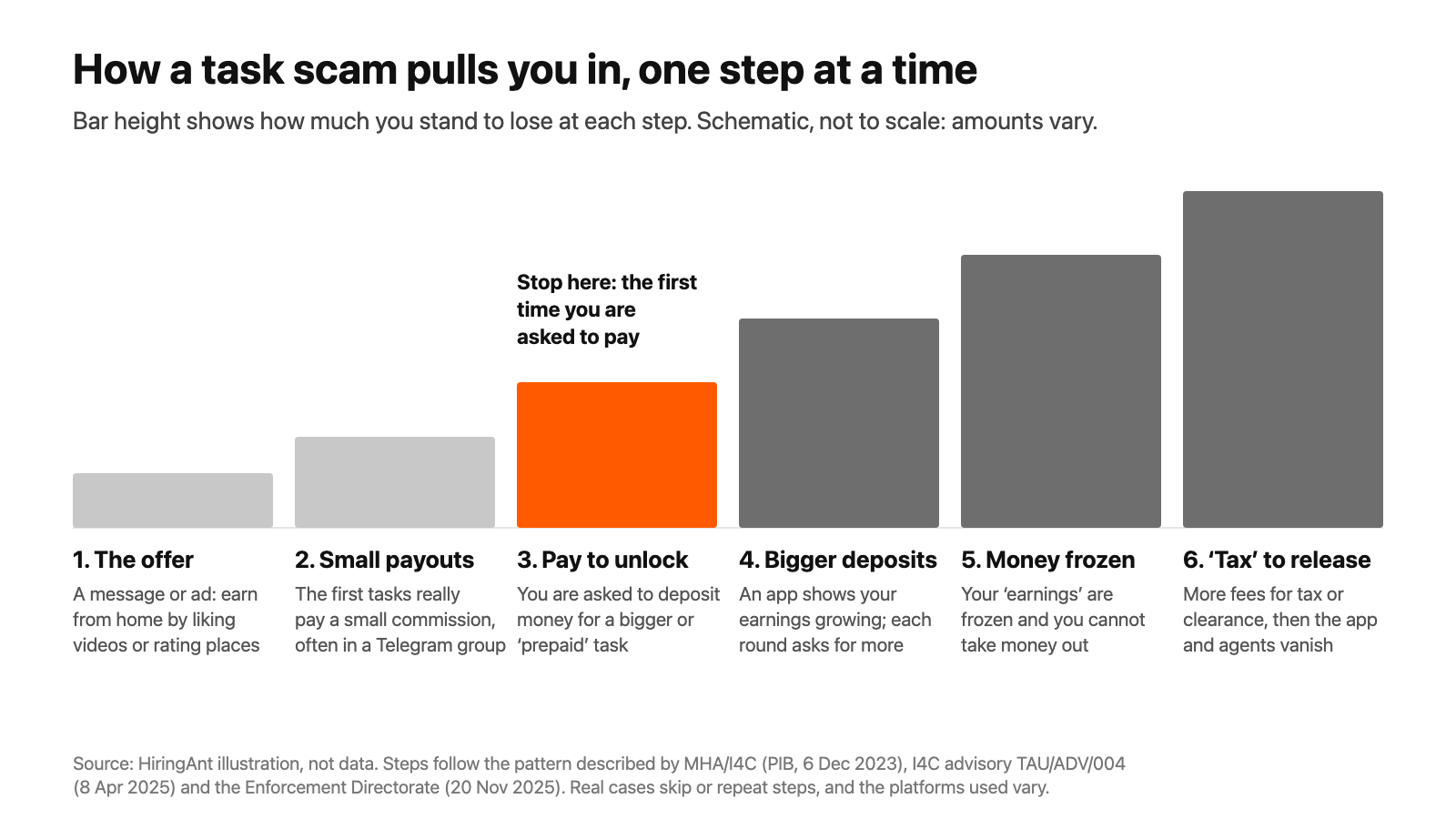
An illustrative pattern drawn from Home Ministry, I4C and Enforcement Directorate descriptions, not data. The first request to pay is the moment to stop.
The money moves fast. In that one ED case, ₹285 crore was collected in more than 30 bank accounts that were each used for only 1 to 15 days, then moved on to over 80 other accounts, partly through cryptocurrency (ED, 2025). That is why reporting quickly matters so much.
What other fake job scams should you watch for?
The task scam is one of several. These are the others that official advisories describe:
- An offer letter with a fee. Fraudsters pose as officials of well-known companies, hold fake interviews and offer you a job, then ask you to pay for registration, a "mandatory" training programme or a laptop (RBI, BE(A)WARE).
- Fake HR using a real company's name. An SMS says "Your CV has been selected" and carries a link that opens a WhatsApp chat with the "recruiter", who sends you to a registration site (I4C, 2022). Real employers say plainly that they do not hire this way. Amazon, for example, says it charges no fee at any stage of hiring, that an email not ending in @amazon.com is most likely not genuine, and that contact over WhatsApp or Telegram is a warning sign (Amazon, India fraud alert).
- Fake "assessment" apps. You are told to install an app from a link to take a test or join an interview. The RBI warns that an unverified app can give fraudsters complete access to your device, including your OTPs, and that a screen-sharing app lets them watch or control your phone and reach your banking details (RBI, BE(A)WARE).
- Data and KYC harvesting. A fake job site's "registration" asks for your bank, credit card or debit card details, and your accounts are compromised (RBI, BE(A)WARE). Stolen personal details are then used for further fraud (I4C, 2022).
- CAPTCHA and data-entry "jobs". I4C reported a significant rise in complaints in 2025. Victims pay a registration, training or software fee, solve thousands of CAPTCHAs, and after weeks are told their work had errors, so nothing is paid (I4C, 2025).
- Recruiting you as a money mule. The "job" is to receive money into your bank account and pass it on, or withdraw it as cash, for a commission. The RBI says the account holder then becomes the target of a police investigation for money laundering (RBI, BE(A)WARE). A newer version pays you to link your WhatsApp to an app by scanning a QR code, which turns your account into a tool for scams. I4C warns that renting out your WhatsApp and receiving illegal funds can lead to arrest (I4C, 2025).
- Jobs abroad. The Embassy of India in Yangon has warned that Indians recruited through social media for jobs abroad have been trafficked, via Thailand, to crime syndicates on the Myanmar-Thailand border. It advises verifying any foreign employer through the Indian Embassy in that country (Embassy of India, Yangon, 2024).
Mule accounts are not rare. Under the Suspect Registry that I4C runs with banks, 32.08 lakh first-layer mule accounts had been shared with participating banks and institutions by 30 June 2026 (PIB, 2026).
The 5-minute check for any job offer
Run these checks before you reply, pay, click or install anything. Most offers fail at step 1.
- Did they ask you for money? Then stop. Registration fee, training fee, laptop, "prepaid task", tax: the answer is no every time (RBI, BE(A)WARE).
- Check the email address. A real recruiter writes from the company's own domain. A Gmail or Yahoo address, a lookalike domain, or only a WhatsApp number are warning signs.
- Find the job yourself. Type the company's website into your browser instead of clicking the link you were sent, and look for the role on its careers page. Then call the company on a number from its own website, not the one in the message. Some employers have their own way to verify an offer; Amazon, for example, says its offer documents can be downloaded only from its official joining site (Amazon, India fraud alert).
- Check the recruiter. On LinkedIn, look for a real work history at that company, not a new profile with few connections. Ask for an official email, and reply only there.
- Search before you trust. Search the company name with "scam", "fraud" or "complaint" (I4C, 2022). Reverse-search the offer letter: run a screenshot through Google Lens, or search one exact sentence in quotes. Scam letters are reused.
- Never install an app, APK file or screen-sharing tool sent to you in a chat. The RBI advises installing screen-sharing apps only on advice from a company's official toll-free number, never from an "executive" calling from a personal number (RBI, BE(A)WARE).
- Never share an OTP, UPI PIN, card details or bank login, and never send KYC documents into a chat. An RBI review of complaints found that customers sharing confidential information is one of the major causes of financial fraud (RBI, 2022).
- Look at who you would pay, and notice the rush. Check the receiver's name in your UPI app; if it is some random person, it may be a mule account (PIB, 2023). Pressure to act today is itself a warning sign (I4C, 2022).
Some genuine recruiters do message on WhatsApp to set up a call, so the app alone proves nothing. What matters is what they ask for. A real recruiter will happily move to official email, will never charge you, and will never pay you to like videos.

If you have already paid: what to do, in order
First, this is not your fault, and acting now gives you the best chance. Telangana's Malkajgiri Police calls the first hour after a cyber fraud the "golden hour": prompt action then can help stop transactions and freeze accounts before more is lost (Malkajgiri Police).
- Call 1930 immediately. It is the toll-free national cybercrime helpline, answered by your state's police. Give your name, mobile number, address and the transaction details, and you will get an acknowledgement number by SMS (I4C FAQ).
- File the full complaint on cybercrime.gov.in within 24 hours, using that acknowledgement number (I4C FAQ). If you cannot get through on 1930, file directly on the portal; online financial fraud is one of its categories.
- Call your bank on the number printed on your card or on its official website. Tell it what happened, and if you shared card or login details, block the card and change your passwords (I4C, 2021).
- Stop paying, whatever they say. Every "tax", "unlock" or "upgrade" fee is part of the same scam. Be wary of anyone who contacts you afterwards offering to recover your money for a fee. Calling 1930 and filing a complaint cost nothing.
- Save the evidence before you block anyone. Take screenshots of the chats, and note group names, Telegram links, phone numbers, UPI IDs, bank account numbers, transaction reference (UTR) numbers, and app or website names. Keep any offer letter. Do not delete the chats.
- Report the number on Sanchar Saathi. The Department of Telecommunications' Chakshu service takes reports of suspected fraud by call, SMS or WhatsApp, and asks for them within 30 days. Chakshu itself says that if you have lost money, report to 1930 or cybercrime.gov.in, so do that first.
- Report the accounts on WhatsApp and Telegram. In WhatsApp, use Block and Report on the chat, and open Linked Devices to log out any device you do not recognise (I4C, 2025). In Telegram, tap and hold a message (right-click on desktop), choose Report and pick a reason; you can also email [email protected] with the t.me links (Telegram FAQ).
- Clean up your phone. Uninstall any app or screen-sharing tool they had you install (RBI, BE(A)WARE), and change your UPI PIN and banking passwords if you shared them.
Fast reports do stop money. The system behind 1930 has saved more than ₹11,158 crore across more than 32.80 lakh complaints since it launched in 2021, as of 30 June 2026 (PIB, 2026). That figure covers all financial cyber fraud, not just job scams, and there is no guarantee for any single case: money that has already passed through several accounts is much harder to stop.

What if your "job" was to receive or move money?
Stop at once. Do not forward or withdraw any more money for them, and unlink any devices from your WhatsApp. Tell your bank and report it on 1930 or cybercrime.gov.in, explaining exactly how you were recruited, with the same evidence as above.
Being honest early helps you. The RBI says that if the source of the money is not genuine, the person who received it is likely to land in serious trouble with the police (RBI, BE(A)WARE), and the Home Ministry warns that dealing with unknown accounts can lead to your own account being blocked and legal action (PIB, 2023). This is general information, not legal advice; if the police or your bank contact you about your account, cooperate fully and consider speaking to a lawyer.
Frequently asked questions
They paid me first, so it must be real?
No. Small early payouts are part of the scam, described in the Home Ministry's own account of how these frauds work (PIB, 2023). They exist to win your trust before the deposits.
Can I get my money back?
Sometimes, and your chances are best when you report within the first hour. Frozen money is returned to victims through a legal process that takes time; the Home Ministry says it has set up a module to speed up restoring it to victims (PIB, 2026). Keep your acknowledgement number and follow up with the police station handling your complaint.
A company says training or a laptop is compulsory and I must pay. Is that ever real?
Not for getting hired. The RBI names registration, training and laptop payments as a common job-fraud trick, and says a genuine company offering a job will never ask you for money (RBI, BE(A)WARE).
Wanting work is not a mistake
These scams target people at a hard moment: a first job search, a layoff, a need for income from home. The fix is a habit, not suspicion of everyone: pause at the first request for money, and check the offer through channels you found yourself.
Applying for jobs on HiringAnt is free. If anyone asks you to pay to be hired, whatever company or platform they name, walk away and report it.
When you are ready to apply for real roles, make your resume easy for screening software to read with our ATS-friendly resume guide. Our AI interview preparation guide shows what a genuine online first round looks like, and freshers can start with our campus placement preparation guide.
Sources
- LocalCircles, "WhatsApp frauds and scams becoming increasingly common; 12% admit they have faced impersonation", 2025
- Press Information Bureau, Ministry of Home Affairs, release on over 100 websites blocked for task-based part-time job frauds, 6 December 2023
- Press Information Bureau, Ministry of Home Affairs, "CFCFRMS 2.0 Platform", 28 July 2026
- Directorate of Enforcement, Hyderabad Zonal Office, press release on part-time job and fake app cyber fraud, 20 November 2025
- Indian Cybercrime Coordination Centre, "Part Time Job Frauds/Ponzi Scheme frauds using Websites or Apps", 2021
- Indian Cybercrime Coordination Centre, "Fraudsters sending Fake Job Offer SMSs to perpetrate Cyber Crime", 2022
- Indian Cybercrime Coordination Centre, Advisory TAU/ADV/004, "Rise in Fake Captcha Filling Jobs based cybercrime", 2025
- Indian Cybercrime Coordination Centre, Advisory TAU/ADV/005, "WhatsApp Web Account Renting Scam", 2025
- Embassy of India, Yangon, "Advisory regarding fake job racket targeting Indian youth", 2024 (hosted by I4C)
- Indian Cybercrime Coordination Centre, Frequently Asked Questions
- Reserve Bank of India, "BE(A)WARE: A booklet on modus operandi of financial frauds"
- Reserve Bank of India, "BE(A)WARE – A Booklet on Modus Operandi of Financial Frauds", press release, 2022
- Department of Telecommunications, Sanchar Saathi, "Chakshu: Report Suspected Fraud Communication"
- Malkajgiri Police Commissionerate, Telangana, "DCP – Cyber Crime" and the golden hour
- Telegram, FAQ
- Amazon, "Fraud Alert" for India
Avanish Patidar
Co-Founder & CTO HiringAnt
AI engineer, builder, and lifelong learner passionate about turning ambitious ideas into real products. I spend my time building AI agents, voice interviewers, and recruitment systems that help people discover better opportunities and companies hire exceptional talent. Driven by curiosity, innovatio
LinkedIn