Careers··14 min read
Using ChatGPT for your job search without sounding like everyone else
Recruiters rarely mind that you used ChatGPT. They mind text that is generic, unedited or impossible to back up. This guide shows what recruiters say they notice, where AI genuinely helps in a job search, where it quietly hurts you, the honesty line employers draw, how to keep your personal data out of chatbots, and copy-paste prompts that make the output sound like you.

Co-Founder & CTO HiringAnt
Use ChatGPT (or Gemini, Claude or Copilot) as an editor and a sparring partner, not as the author of your application. Recruiters do not object to AI as such. They object to text that could belong to anyone, that nobody has edited, or that you cannot back up when they ask about it. Feed the tool your real facts, make it ask you for what is missing, and check every line before it goes out.
At HiringAnt we build the screening software and AI interviewer employers use, so we read a lot of applications from the other side. Here is what recruiters say they notice, where AI genuinely helps, where it quietly hurts, the honesty line employers draw, how to keep your personal data safe, and prompts you can copy.
Key takeaways
Most recruiters have seen AI-written applications; what costs you is generic, unedited text.
AI helps most with reading a job description, finding gaps, tightening your own notes and practising interviews.
It hurts when it invents numbers or skills, reuses everyone's phrases or writes a polished letter about nobody.
The honesty line: never claim anything you cannot explain in an interview, and no AI in a live interview unless the employer says so.
Keep Aadhaar, PAN, phone numbers and salary slips out of chatbots. Replace them with placeholders.
Can recruiters tell you used ChatGPT, and does it hurt you?
Often they can, and what they react to is the generic, unedited text rather than the use of AI itself.
In a 2025 online survey of 1,013 HR professionals across 59 countries, run by the resume-builder company Jobseeker, 81.6% said they had already come across AI-written cover letters. The cues they named most were a lack of personalisation (61.1%), style and tone (59.8%) and overly generic phrasing (57.4%). And 54% said they were less likely to move forward with unedited AI content (Jobseeker, 2025).
Resume Genius, another resume-builder company, surveyed 1,000 US hiring managers through Pollfish. 77% said many resumes look completely or partly AI-generated, and the giveaways they named were unnatural phrasing or tone (51%), repetitive or generic language (44%) and vague or inflated descriptions (41%). 76% said AI-written resumes make it harder to tell what a candidate actually did (Resume Genius, 2026).
These are vendor surveys, mostly of recruiters outside India, so read them as direction rather than precise measurement. The direction is consistent, though: polish is no longer rare, so it no longer stands out. Specific, checkable detail does.
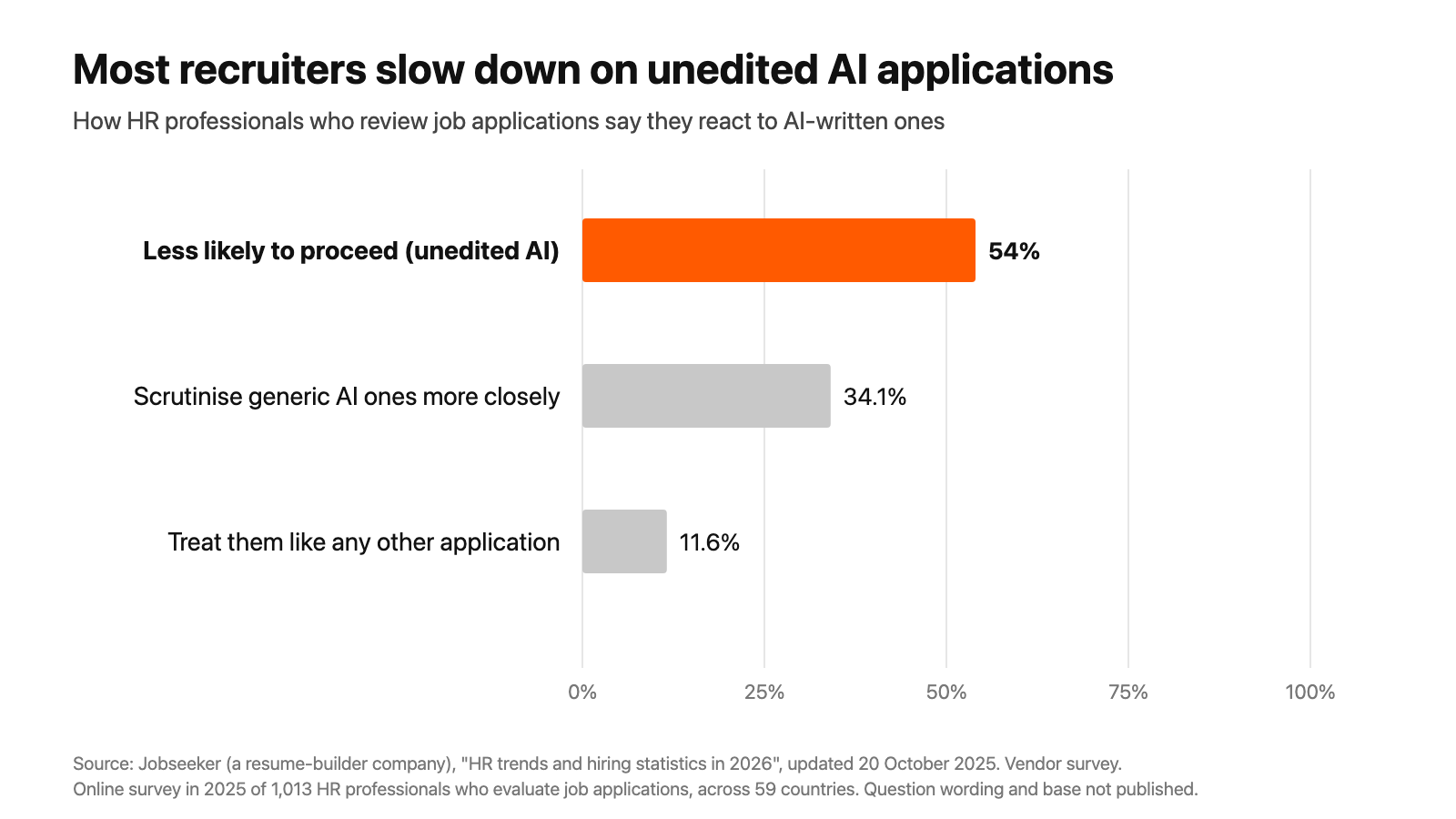
Only about one in nine recruiters in this vendor survey treat AI-written applications like any other. Jobseeker survey of 1,013 HR professionals, 2025.
Everyone is using it, so what makes you stand out?
You are not the only one with ChatGPT open. LinkedIn's research, run by Censuswide in November 2025 among 19,113 people in markets including India, found that 81% have used or plan to use AI in their job search (LinkedIn, 2026). In a Greenhouse survey, 74% of US job seekers said they personally use AI (Greenhouse, 2025).
So when a data analyst opening in Bengaluru draws a pile of applications, many of those applicants asked the same tool the same question and got similar answers. Your edge is the material only you have: the actual project, the actual number, the actual problem you solved.
Where does AI genuinely help in a job search?
Where it works on your facts, and you stay the judge.
Decoding a job description. Ask it to separate must-haves from nice-to-haves and explain jargon. Useful when a JD is a long wish list.
Finding gaps between your resume and the JD. It is good at side-by-side comparison. You decide what to do about each gap.
Turning rough notes into clear bullets. Give it what you did, the tool and the result, and let it tighten the sentence. Then fact-check every word.
Practising interview answers. Ask it to play the interviewer and push back on vague answers. This is the most underused, lowest-risk use.
Preparing questions to ask. Good questions about the team and the first 90 days show you have thought about the job.
Framing salary conversations. It can help you phrase an expected CTC range and list what to ask about fixed versus variable pay. It is not a reliable source of the market number itself.
Format and parsing are a separate problem; our ATS-friendly resume guide covers layout, headings and the copy-paste test.
Where does AI quietly hurt your application?
Invented metrics and skills. Ask a chatbot to "make this bullet more impressive" and it may add "improved efficiency by 35%" or a tool you never used. If it is in your resume, an interviewer can ask you about it.
Everyone's template phrases. "Results-driven professional", "leveraged cutting-edge", "spearheaded cross-functional synergy". Recruiters see these all day. They say nothing about you.
Over-polished cover letters. A flawless letter that could go to any company reads as a form letter. Two plain sentences about why this role and what you did that fits beat a page of adjectives.
Mass-applying. AI makes it easy to fire off 50 applications a day. A tailored application to 10 roles you fit usually beats an untailored one to 100.
Hidden-text tricks. In the Greenhouse survey, 41% of US job seekers admitted using prompt injections, hidden text meant to get past AI filters. Hiring managers are watching for it: 65% said they had caught applicants using AI deceptively (Greenhouse, 2025). White text can show up in black in the profile a recruiter reads.
What does a generic AI bullet look like next to a specific one?
Say you are a data analyst with two years at an e-commerce company in Pune. Ask a chatbot for "a strong resume bullet for a data analyst" and you get something like this:
Generic: Leveraged advanced data analytics to drive actionable business insights and spearhead cross-functional collaboration, resulting in improved operational efficiency.
It is grammatical and empty. Which data? Which tool? Which insight? Improved by how much? Now give the tool your notes and tell it to use only your facts:
Specific: Built a weekly Power BI dashboard of late returns by pin code for the Pune warehouse team; it showed two courier partners caused 40% of delays, and the team moved those routes in March.
Every part of the second bullet is something you can talk about for two minutes in an interview. That is the test. (The numbers here are an illustration; use yours, or none.)
Copy-paste prompts that make the output sound like you
Fill the square brackets, paste your own material, and keep the rules in each prompt. They do most of the work.
1. Decode the job description
Here is a job description for [role] at [company]. Tell me:
1. The 5 must-have skills or experiences, in order of importance.
2. The nice-to-haves.
3. What the day-to-day work probably involves, in plain English.
4. Any jargon or abbreviations, explained.
Only use what is in the text. If something is unclear, say so instead of guessing.
[paste job description]
2. Find the gaps between your resume and the JD
Compare my resume with this job description. For each must-have in the JD, say whether my resume shows it clearly, mentions it without evidence, or does not mention it. Quote the line from my resume you are relying on.
Do not suggest adding any skill, tool or number I have not given you. If something is missing, ask me whether I have done it.
Job description: [paste]
My resume: [paste, with personal details removed]
3. Turn rough notes into bullets
Here are my rough notes about one piece of work. Turn them into 2 resume bullets.
Rules: start with a verb; name the tool; end with the result.
Use only the facts and numbers in my notes. If a result has no number, write [NUMBER?] so I can fill it in or remove it. Never estimate.
Do not use these words: leveraged, spearheaded, synergy, dynamic, passionate, results-driven, cutting-edge, seamless.
Notes: [what you did, which tools, for whom, what changed]
4. Review your cover letter, don't rewrite it
Here is a cover letter I wrote for [role] at [company], and the job description. Do not rewrite the letter. Instead:
- Mark any sentence that could appear in anyone's cover letter.
- Mark anything that sounds over-formal or unlike a person talking.
- Tell me which part of the JD my letter does not address. Keep my tone. Suggest at most 3 changes.
[paste letter] [paste JD]
5. Practise the interview
Act as an interviewer for a [role] position at a [type of company] in India. Use this job description.
Ask me one question at a time and wait for my answer. After each answer, ask one follow-up that presses on the vaguest part of what I said.
After 5 questions, tell me which answer was weakest and why, and what a stronger answer would have included.
[paste JD]
6. Prepare questions to ask the interviewer
Based on this job description, suggest 8 questions I could ask the interviewer about the team, how success is measured in the first 90 days, and how the role might change in the next year. Avoid questions the JD already answers. Do not state facts about the company unless they are in the JD.
[paste JD]
7. Frame your expected CTC
I am a [role] with [X] years of experience in [city]. My current CTC is [amount], of which [amount] is fixed. Help me prepare for "What is your expected CTC?"
Give me 3 honest ways to state a range, and the questions I should ask about fixed versus variable pay, joining bonus and notice period buyout.
Do not give me a market salary figure. Tell me what kinds of sources I could check one against.
For prompt 5, structure your practice answers with the STAR method. For prompt 7, if a buyout comes up, our notice period guide explains how they work.
Where is the honesty line?
Never claim anything you cannot back up in an interview. If a chatbot adds a tool, a number or a responsibility, delete it or make it true. Interviewers ask "Tell me more about that", and a polished line you cannot explain does more damage than a plain one you can.
Employers increasingly write their rules down, and the pattern is consistent: AI to refine your own material is fine, AI in a live interview is not. Anthropic, for example, asks candidates to write their own first drafts and then use its assistant to refine them, and allows no AI in live interviews unless it says otherwise (Anthropic, 2025). Deliveroo lets candidates use generative AI to sharpen the wording of a CV or cover letter that reflects their own experience, bans it in all live interviews, and allows it in take-home tasks unless told otherwise, provided you disclose how you used it (Deliveroo).
Hiring managers say the same. In a TopResume survey of 600 US hiring managers, 52% said AI for proofreading or drafting support is acceptable, while 57% said real-time tools such as answer-generating apps should never be used in conversations with employers (TopResume, 2025).
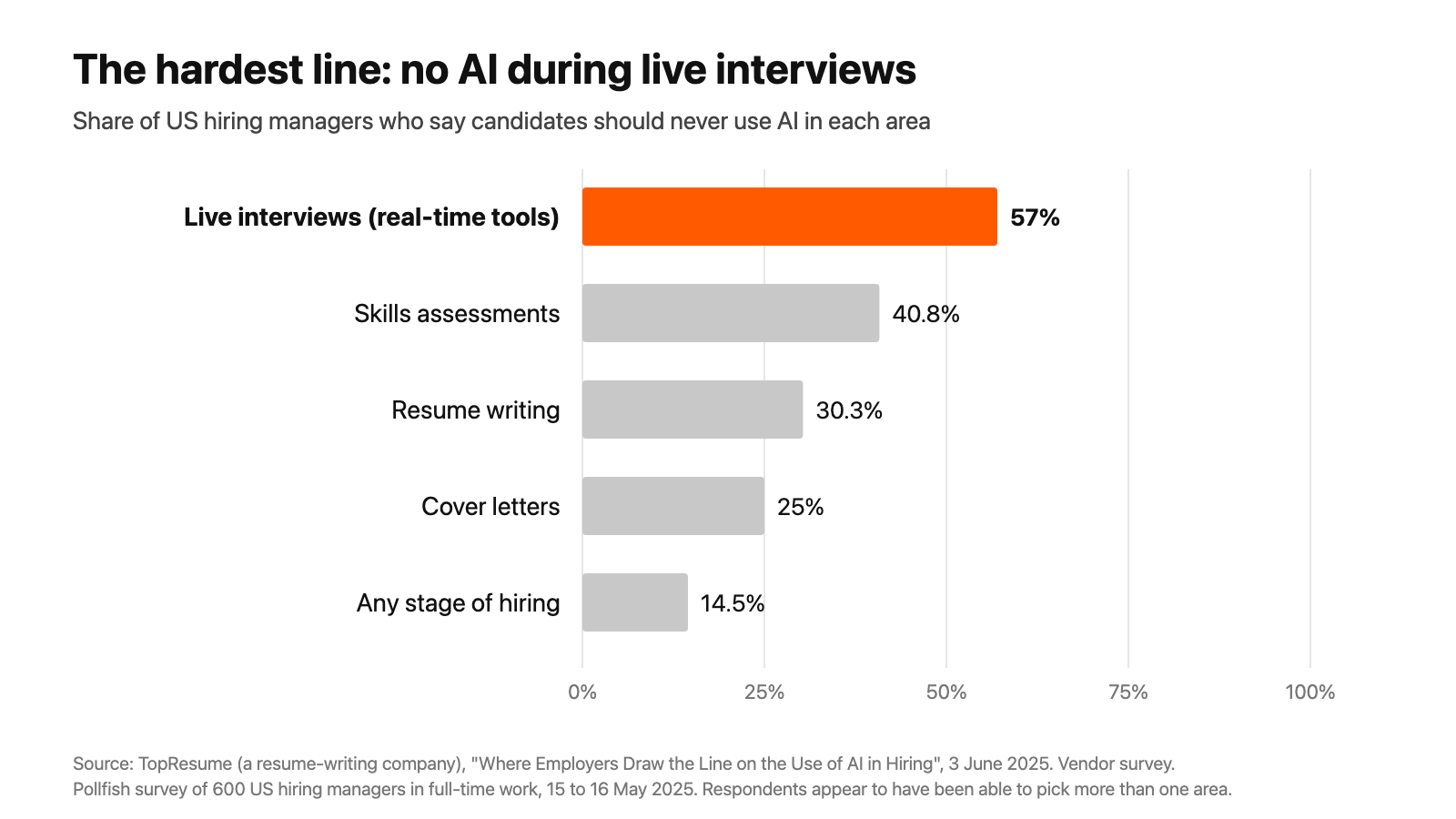
The closer you get to proving a skill live, the less AI hiring managers accept. TopResume survey of 600 US hiring managers, May 2025.
In practice:
Application materials: use AI to edit your own draft. Disclose it if the form asks.
Online tests and assessments: read the instructions. Online tests in campus and lateral hiring drives are often proctored; if the rules say no outside help, that includes chatbots.
Take-home tasks: use AI only if the brief allows it, and say what you used it for.
Live interviews, video or in person: no AI unless the employer explicitly allows it. That includes reading from an AI script on a second screen.
AI interviews: the same rule applies. Our AI interview preparation guide covers how they are scored.
When in doubt, ask the recruiter: "Is it fine to use AI tools for this task?" It is a normal question now.
How do you keep your personal data out of chatbots?
Treat a chatbot like a stranger's laptop. Google's own help page for Gemini says some chats are read by human reviewers and puts it plainly: "Please don't enter confidential information that you wouldn't want a reviewer to see" (Google, Gemini Apps Privacy Hub). Other assistants have their own data settings; check them before you paste anything.
Before you paste your resume or any document:
Never paste your Aadhaar, PAN, passport number, bank details, date of birth or full home address. A chatbot needs none of it to improve a bullet.
Swap personal details for placeholders: [NAME], [PHONE], [EMAIL], [CITY].
Leave out salary slips, offer letters and Form 16. For CTC prompts, type the numbers yourself and round them.
Protect your current employer. Replace client names, internal revenue figures and project code names with general descriptions such as "a large Indian bank".
Check the data settings of the tool you use, and remove old chats you no longer need.
Your ChatGPT job search checklist
Write your own rough draft or notes first, with real facts and numbers.
Remove Aadhaar, PAN, phone, address and employer secrets before pasting anything.
Use prompts that forbid invented facts and ask for [NUMBER?] placeholders.
Delete every template phrase: leveraged, spearheaded, results-driven, synergy.
Read each line aloud and ask: "Could I talk about this for two minutes?"
Check that tools, dates and numbers match your resume, LinkedIn and form answers.
Tailor each application to the JD; apply to fewer roles, better.
Use AI to practise interviews, then answer the real one without it.
Follow each employer's rules for tests, take-homes and interviews; ask when unsure.
Frequently asked questions
Is it wrong to use ChatGPT for my resume?
No. Using it to edit your own draft, fix grammar or tighten wording is widely accepted. The problems are invented content and generic text. Anything it adds, you must be able to explain.
Should I tell employers I used AI?
If the application form or the employer's policy asks, yes, honestly. Otherwise, edited application materials do not usually need a note. For take-home tasks, say what you used AI for unless the brief says otherwise.
Can AI detectors flag my resume?
You cannot know which tools a recruiter uses, so don't write to fool a detector. Write so a person can see what you did, in specifics. That reads as human because it is.
Can I use ChatGPT during an online interview?
Not unless the employer explicitly allows it. Employers that publish rules, such as Anthropic and Deliveroo, rule it out in live interviews, and reading from a screen is easy to spot. Practise beforehand instead.
Which is better for a job search: ChatGPT, Gemini, Claude or Copilot?
Any of them works for the uses in this guide. What matters is the material you give them and the rules in your prompt, not the brand.
Practise with AI, then sound like yourself
The best use of AI in a job search is the one an employer never sees: rehearsal. If you want practice that pushes back, Career Pro runs AI mock interviews for your role, follows up on what you actually said, and gives feedback on every answer. The first two are free, and practice rounds are private: employers never see them.
Then go into the real interview with your own words, and stories you know are true.
Sources
Jobseeker, "HR trends and hiring statistics in 2026", updated 20 October 2025 (vendor survey: 1,013 HR professionals, 59 countries, 2025)
Resume Genius, "2026 Hiring Insights Report: ATS, AI, and Employer Expectations", 2026 (vendor survey: 1,000 US hiring managers, via Pollfish)
Greenhouse, "An AI Trust Crisis: 70% of Hiring Managers Trust AI to Make Faster and Better Hiring Decisions, Only 8% of Job Seekers Call it Fair", 19 November 2025 (vendor survey: 4,136 respondents in the US, UK, Ireland and Germany; figures quoted here are from the US subsample)
LinkedIn, "LinkedIn Research: Nearly 80% of people feel unprepared to find a job in 2026, as two-thirds of recruiters say it's harder to find quality talent", 7 January 2026 (Censuswide survey of 19,113 consumers, November 2025, markets including India)
TopResume, "Survey: Where Employers Draw the Line on the Use of AI in Hiring", 3 June 2025 (vendor survey: 600 US hiring managers, via Pollfish, May 2025)
Anthropic, "How to collaborate with Claude during our hiring process", updated 10 July 2025
Deliveroo Careers, "Using generative AI in your interview process", accessed 2026
Avanish Patidar
Co-Founder & CTO HiringAnt
AI engineer, builder, and lifelong learner passionate about turning ambitious ideas into real products. I spend my time building AI agents, voice interviewers, and recruitment systems that help people discover better opportunities and companies hire exceptional talent. Driven by curiosity, innovatio
LinkedIn