Careers··13 min read
Freshers in 2026: where entry-level jobs shrank, where they are growing, and what to do about it
AI is not simply killing fresher jobs in India. The market is splitting: in September 2026, overall fresher hiring grew 1% while fresher hiring for AI/ML roles grew 19%, and banking, pharma, healthcare and oil and gas added freshers even as IT services slowed. Here is what the data shows, which skills and proof of work move a shortlist, where to look beyond mass campus drives, and a month-by-month plan for your final year.

Co-Founder & CTO HiringAnt
AI is not simply wiping out fresher jobs in India. The market is splitting. In September 2026, fresher hiring on Naukri grew just 1% year on year, IT services hiring fell 4%, and yet fresher hiring for AI/ML roles grew 19%, while banking, pharma, healthcare and oil and gas added freshers at double-digit rates (Naukri JobSpeak, September 2026). So the question is no longer "are there jobs?" but "which ones, and what proof gets me shortlisted?"
This guide is for final-year students and recent graduates in any stream: engineering, commerce, arts or science. It covers what the latest data says, which skills and projects actually move a shortlist, where to look beyond mass campus drives, and a month-by-month plan from now until you join.

Key takeaways
- Overall fresher hiring is flat, not collapsing: +1% year on year in September 2026 on Naukri.
- Growth has moved to AI/ML roles, to global capability centres (GCCs), and to non-IT sectors such as banking, pharma, healthcare and oil and gas.
- Employers now screen for AI fluency, problem solving and the ability to learn, not just a degree and a CGPA.
- Two projects you can explain end to end, built on a real problem, beat a long list of certificates.
- Internships, smaller firms, tier-2 cities and apprenticeships are real routes in. Plan for them from now, not after your last campus drive.
Is AI really killing fresher jobs in India?
Not across the board. Here is what the most recent monthly data shows.
- Overall white-collar hiring rose 2% year on year in September 2026 (Naukri JobSpeak, September 2026).
- Fresher hiring (0 to 3 years of experience) rose 1%. The 4 to 7 year band fell 2%. Experienced bands grew faster: 5% for 8 to 12 years and 7% for 13 to 16 years.
- AI/ML roles grew 20%, and fresher hiring for AI/ML roles grew 19%.
- IT/software services hiring fell 4%. Even inside IT, though, AI/ML hiring grew 11%.
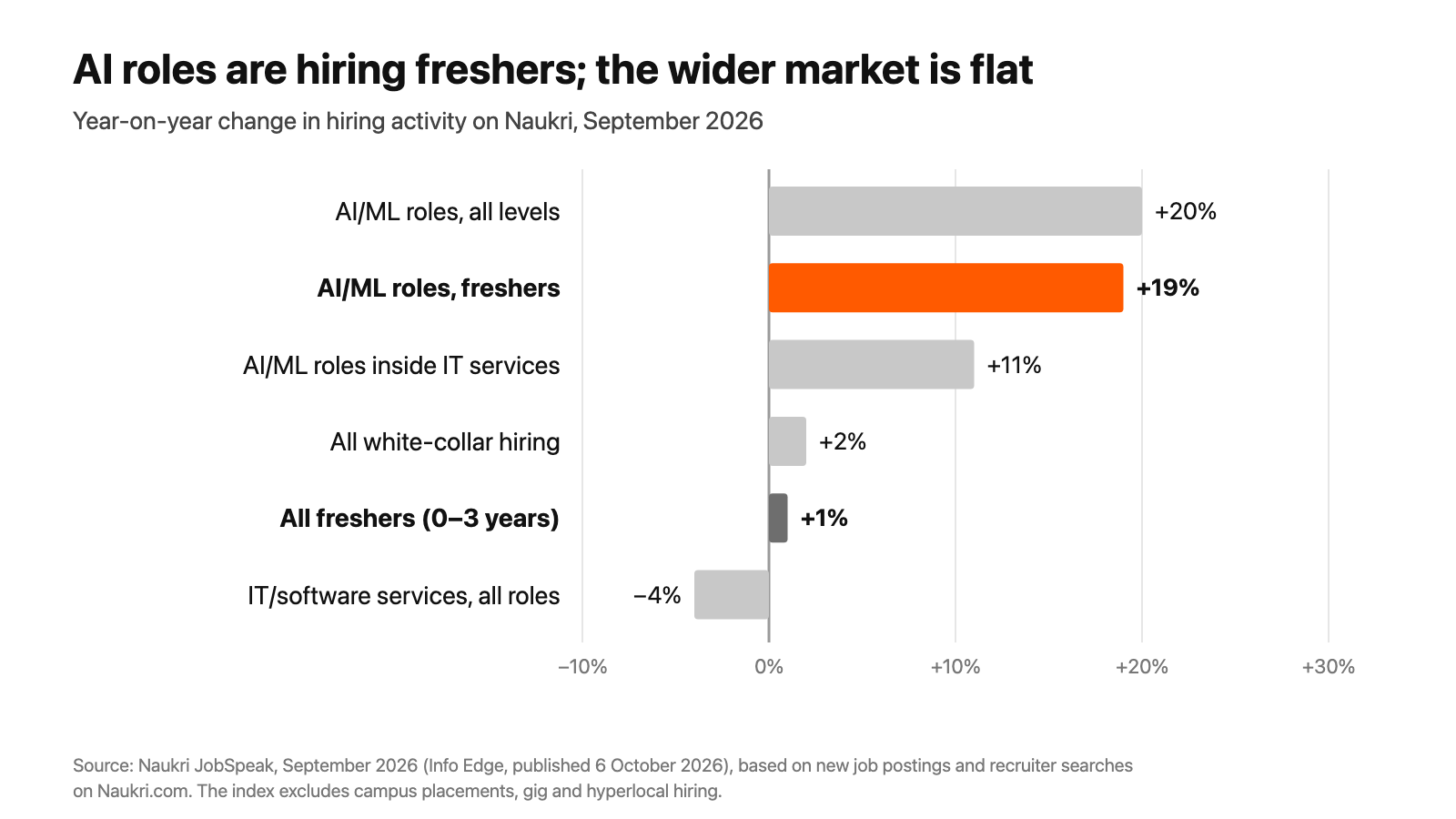
Naukri JobSpeak, September 2026. One month of job postings and recruiter searches, not total jobs.
The IT industry body tells the same story from the employer side. Nasscom estimates India's tech sector will employ about 60 lakh people in FY26, up only 2.3%, a net addition of 1.35 lakh, while revenue grows 6.1%. It expects hiring "to shift from volume to skill mix", with firms prioritising "AI fluency, problem-solving ability and learnability at fresher levels" (Nasscom Strategic Review 2026).
So the honest picture is this: the old model, where large IT services firms hired freshers by the thousand and trained them from scratch, is getting smaller. Hiring for specific skills, in specific sectors and cities, is growing.
Two caveats before you read too much into any single number:
- Monthly data is noisy. Fresher hiring grew 15% in August 2026, but Info Edge's CEO said that month should be read against a festive calendar that shifted from August last year to September this year (Naukri JobSpeak, August 2026). Look at the trend over several months, not one headline.
- JobSpeak does not count campus placements, gig work or hyperlocal hiring. It tracks new job postings and recruiter searches on Naukri (Naukri JobSpeak, September 2026 report). It tells you which way off-campus demand is moving, not how many people got jobs.
Where did entry-level hiring shrink, and where is it growing?
Where it is cautious. In September 2026, overall hiring fell in IT/software services (−4%), FMCG (−4%), pharma (−4%), hospitality (−11%) and education (−18%) (Naukri JobSpeak, September 2026). If your whole plan is "clear one mass IT services drive", you are betting on the slowest-moving part of the market.
Where it is growing.
- Freshers outside IT. Fresher hiring grew 21% in oil and gas, 14% in banking and financial services, 10% in pharma and biotech and 10% in healthcare. In pharma and healthcare, overall hiring fell that month while fresher hiring rose (Naukri JobSpeak, September 2026).
- GCCs. Global capability centres, the Indian offices that multinationals run for their own technology, finance and operations work, grew hiring 4%, led by Hyderabad (+23%), Chennai (+13%) and Pune (+11%). In the BPO/ITES sector, GCC hiring grew 59% (Naukri JobSpeak, September 2026 report).
- Smaller cities. Coimbatore (+20%) and Vadodara (+13%) were Naukri's fresher hiring hotspots in September (Naukri JobSpeak, September 2026 report). LinkedIn's data for India's Class of 2026 puts Vijayawada top for early-career hiring growth, followed by Kolkata and Bhopal (LinkedIn News India, Grads' Guide 2026).
- New kinds of roles. On LinkedIn, the three fastest-growing job titles for India's career starters are AI Specialist, Generative AI Engineer and Digital Content Creator, and the fastest-growing functions for graduates are HR and consulting (LinkedIn News India, Grads' Guide 2026).
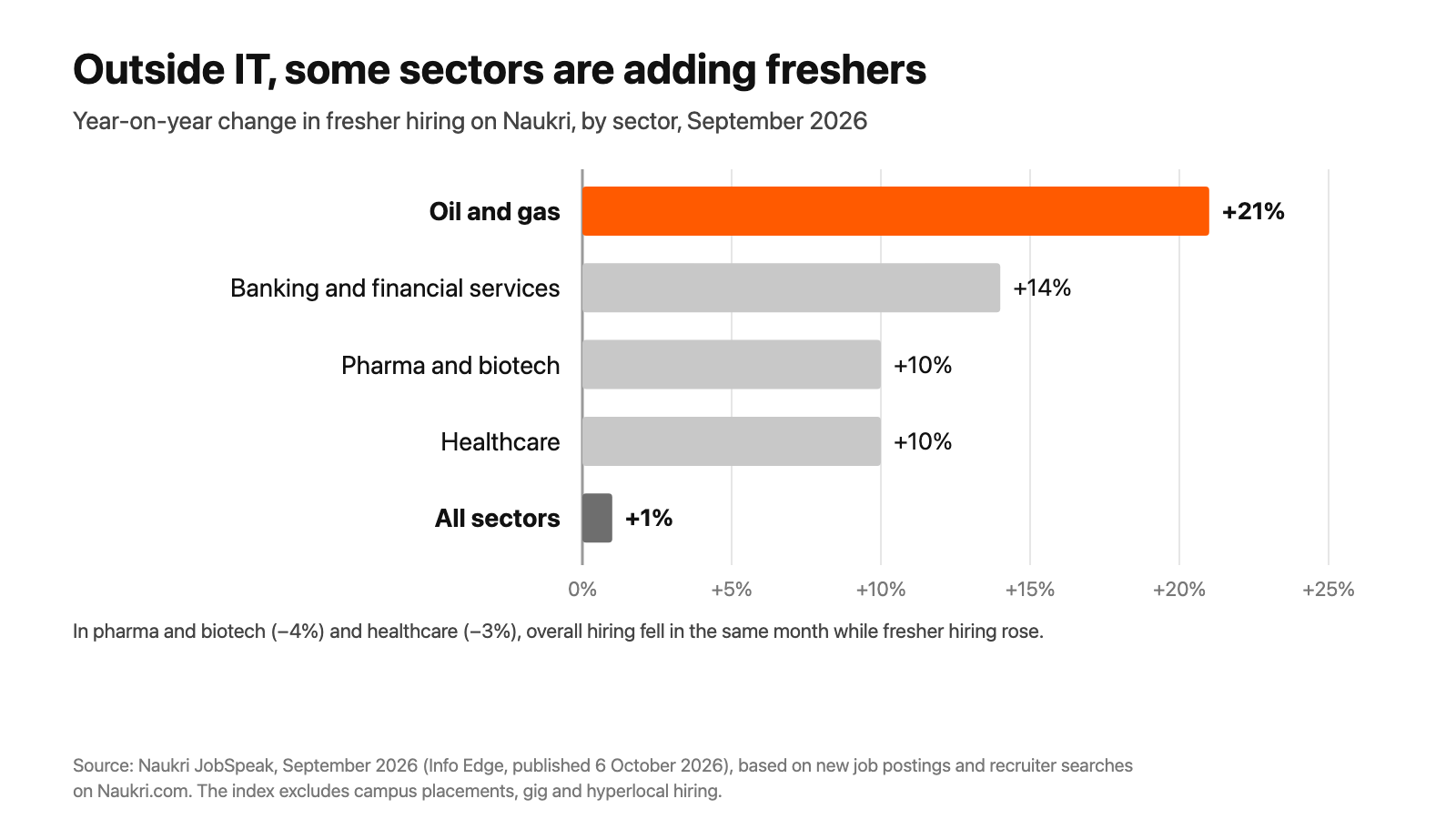
Naukri JobSpeak, September 2026. Fresher hiring grew in these sectors even where overall hiring fell.
What this means for you: a commerce graduate in Indore or a B.Sc. graduate in Coimbatore is not locked out because IT services is slow. The growth is spread across more sectors and cities than the "AI is killing jobs" headlines suggest.
What do employers look for in a fresher now?
Three sources, from three different angles, point the same way.
- Nasscom: AI fluency, problem solving and learnability at fresher level (Nasscom Strategic Review 2026).
- Deloitte India, surveying 257 organisations and 505 campuses: AI and data skills (AI development, cybersecurity, data science, Industry 4.0) earn campus hires a 20 to 25% pay premium, and analytical thinking and problem solving earn 10 to 15%. For predicting who converts an internship into a pre-placement offer (PPO), employers rank behavioural competencies (75%) and learning agility (72%) ahead of technical skills (Deloitte India, Campus Workforce Trends 2026).
- LinkedIn's Skills on the Rise 2026 for India lists prompt engineering, workflow automation, data analysis, data storytelling, cloud infrastructure, threat detection, relationship management, negotiation, collaboration and stakeholder management among the fastest-growing skills (LinkedIn News India, February 2026).
Notice the mix: about half of those are not technical. Here is what to build, by stream.
- Engineering and computer science: one programming language you can code in under pressure, SQL, Git, and basic use of an AI model through an API. Know how to check whether an AI tool's output is right, not just how to prompt it.
- Commerce and BBA: advanced Excel (lookups, pivot tables, a simple dashboard), GST and TDS basics, Tally or another accounting package, and one AI tool for drafting and summarising, used with checking.
- Arts and humanities: clear writing in English and your regional language, research and fact-checking, and one content, design or analytics tool. HR, content and consulting-support roles all value this.
- Science: data analysis in Excel, Python or R, lab documentation, and domain knowledge for pharma, healthcare or biotech roles. Deloitte found a 20 to 25% premium for bioinformatics and biopharma skills too.
Whatever your stream, learn to use AI tools well and say so honestly. That is now a basic expectation, not a bonus.
What proof of work actually moves a shortlist?
Deloitte found that 72% of organisations use AI to screen resumes (Deloitte India, Campus Workforce Trends 2026). We build screening software, so here is how it looks from that side: a screen compares what your resume shows against what the job asks for. "Familiar with Python" shows very little. A project with a problem, your part, the tools and a result shows a lot, and gives the interviewer a question you can already answer.
Good proof of work has four parts: a real problem, something you built or did, a result you can measure, and a short write-up anyone can open.
- Computer science: a small tool that solves a real problem for your college or a local business, such as a timetable clash checker or a stock alert for a medical shop, with the code on GitHub and a one-page README.
- Commerce: take a family business's or a friend's shop's three months of sales and expenses, clean them, reconcile them and build a one-page dashboard. Remove any private details before you share it.
- Arts: a portfolio of five pieces, such as explainers, a newsletter or social posts for a college society, with what you did and how readers responded.
- Science: analyse a public dataset from your field, such as rainfall, crop yields or drug trial summaries, and write up what you found and what the data cannot tell you.
Then make it easy to find. Put two projects near the top of a one-page resume, with a link. Our ATS-friendly resume guide covers the format, and the STAR method helps you explain each project in an interview.
One honest warning: if AI wrote most of your project, an interviewer will find out in two follow-up questions. Use AI to go faster, and make sure you can explain every line and every decision.

Where should you look beyond mass campus drives?
Campus drives still matter. Our campus placement preparation guide covers each stage and the online test. Just don't let drives be your only plan.
- Internships that convert. Employers increased campus recruitment budgets by 19%, and internship-to-PPO conversions improved by about 6% year on year, across every degree category Deloitte covered (Deloitte India, Campus Workforce Trends 2026). Treat an internship as a two-month interview.
- GCCs. Check the India career pages of multinational banks, insurers, retailers, carmakers and pharma companies, not just tech firms. Many run graduate programmes in finance, operations, analytics and technology.
- Smaller firms and startups. A 30-person company may never come to your campus but needs someone who can do one thing well. You often get more responsibility sooner. Check the company is real and read the offer letter carefully.
- Non-IT sectors. Banks, insurers, NBFCs, hospitals, diagnostics chains, pharma companies and energy firms are hiring freshers for operations, sales, analytics, quality and support roles.
- Your own city. If Coimbatore, Vadodara, Vijayawada or Bhopal is home, search there first. Living costs are lower and the competition can be smaller.
- Apprenticeships. The government's National Apprenticeship Training Scheme gives graduate and diploma holders 6 months to a year of paid on-the-job training. It currently covers technical and engineering disciplines, to be extended to commerce, arts, humanities and management, and there is no guarantee of a job afterwards (NATS, Ministry of Education).
To find off-campus roles fast, AI Job Search on HiringAnt is free to try without an account: upload your resume and it searches live job boards and company career pages, then ranks the roles you fit, each with a reason.
Never pay anyone for a job, a "registration fee" or a guaranteed interview. Real employers do not charge you.
A month-by-month plan for your final year
This assumes you are in final year now, in October, with exams around April and May. Shift the months if your calendar is different. Plan on five to seven focused hours a week alongside classes.
- October: pick your direction. Choose two role families, for example "data analyst or business analyst" or "HR or operations". Read 20 real job descriptions for them and list the skills that keep repeating.
- November: close one skill gap. Pick the most repeated skill you lack and give it 30 days. Start project one using that skill.
- December: finish project one and apply for internships. Use the winter break to finish and write it up. Apply for winter and spring internships, including at small firms and GCCs.
- January: build project two and rewrite your resume. Make project two different from the first, for example one technical and one with a business result. Cut your resume to one page with both projects near the top.
- February: apply in a focused way. Send 10 to 15 tailored applications a week across campus, GCC career pages, smaller firms and non-IT sectors. Ask two seniors or alumni for referrals.
- March: practise interviews out loud. Prepare a 60 to 90 second introduction and two minutes on each project. Be ready for an AI round too: Deloitte notes AI-led video interviewing is emerging as a screening tool, and our AI interview preparation guide explains how these rounds are scored. HiringAnt's Career Pro gives you 2 free AI mock interviews with feedback, and employers never see them.
- April and May: protect your exams. Keep applications at a low, steady pace. Follow up once on anything pending. If you will need an apprenticeship, register on the NATS portal now.
- June and after: go full time on the search. Widen your cities and sectors, keep shipping small pieces of work, and compare every offer on role, CTC breakup, bond and location.
If you are already out of college, compress October to January into six weeks and start applying in parallel.
Common mistakes to avoid
- Waiting for campus drives to end before starting an off-campus search.
- Collecting certificates instead of building things. A certificate says you watched; a project shows you can do.
- Applying only to IT services, the part of the market that is growing slowest.
- Hiding AI use, or overclaiming it. Say what you used it for and what you checked.
- Writing off your home city. Several of the fastest-growing hiring locations are tier-2 cities.
Your checklist for this week
- Pick two role families and save 20 job descriptions for them.
- List the five skills those descriptions repeat most, and mark the ones you lack.
- Write down one project idea, tied to a real problem, that uses your weakest skill.
- Shortlist five employers outside mass IT hiring: a GCC, a bank or insurer, a pharma or healthcare firm, a startup and one in your home city.
- Message one senior or alumnus who works at one of them.
- Cut your resume to one page.
Frequently asked questions
Will AI take away all entry-level jobs?
The data does not show that. In September 2026, fresher hiring was flat overall but grew in AI/ML roles and several non-IT sectors. What is shrinking is routine work that software now does faster. Roles that combine a skill, judgement and working with people are holding up better.
Do I need to learn AI if I am not from computer science?
You need to use AI tools well, not build models. A commerce graduate who can use AI to draft a summary and then check every number against the source is more useful than one who cannot. Learn the tools used in your field and practise checking their output.
Is it worth joining a small company as my first job?
It can be. You often get broader work and faster responsibility. Check that the company is registered and has a working website and real employees, read the offer letter, and avoid long bonds or any request for money.
What are GCCs, and do they hire freshers?
Global capability centres are offices that multinationals run in India for their own technology, finance, analytics and operations work. Many hire graduates directly, through their own career pages or through campus. Naukri recorded 4% growth in GCC hiring in September 2026, with Hyderabad up 23%.
What if my college has no good placements?
Then off-campus is your main route, not your backup. Build two projects, apply directly to smaller firms, GCCs and non-IT employers, look at apprenticeships, and ask alumni for referrals. Pay gaps between college tiers are real: Deloitte puts median B.Tech campus pay at ₹18.7 LPA for top-10 institutes against ₹5.75 LPA for tier-3 ones (Deloitte India, 2026). Proof of work, internships and your first two years of experience are how you narrow that gap.
Sources
- Naukri JobSpeak, "White-collar hiring holds steady in September; AI/ML roles continue growth streak", Naukri blog, 6 October 2026
- Info Edge, "Naukri JobSpeak September 2026" report (PDF), 2026
- Info Edge, "Naukri JobSpeak August 2026" report (PDF), 2026
- Nasscom, "Technology Sector in India: Strategic Review 2026, Executive Summary", February 2026
- Deloitte India, "India's campus talent landscape pivots to skill-based hiring as 86 percent of employers adopt AI in recruitment", press release, 27 August 2026
- LinkedIn News India, "Grad's Guide 2026", April 2026
- LinkedIn News India, "Skills on the Rise 2026: The fastest-growing skills in India", 24 February 2026
- National Apprenticeship Training Scheme, Ministry of Education, "About NATS", accessed 2026
Avanish Patidar
Co-Founder & CTO HiringAnt
AI engineer, builder, and lifelong learner passionate about turning ambitious ideas into real products. I spend my time building AI agents, voice interviewers, and recruitment systems that help people discover better opportunities and companies hire exceptional talent. Driven by curiosity, innovatio
LinkedIn