Careers··13 min read
Tell me about yourself answer: a 60 to 90 second structure for freshers, experienced hires and career switchers, with 3 sample answers
Answer in 60 to 90 seconds: what you do now, one or two past things that fit this job, and why you want this role. Skip the family history, the resume reading and salary. Three full sample answers inside.

Co-Founder & CTO HiringAnt
Answer "Tell me about yourself" in 60 to 90 seconds, in three parts: what you do now, one or two things from your past that fit this job, and why you want this role (Texas Tech University Career Center, 2026). It is not a request for your life story or a reading of your resume; it is your first and best chance to pitch why you fit the job (Brandeis University).
Below: the structure with timings, what to leave out, how it changes across HR, technical and AI rounds, and three full sample answers.
Key takeaways
- Aim for 60 to 90 seconds, roughly 160 to 250 spoken words.
- Use present, past, why this role. Give the past the most time, but only the parts that fit this job.
- Leave out family background, Class 10 and 12 marks, a list of hobbies, and salary.
- End with a hand-off: the project you want them to ask about next.
- Prepare key phrases, not a memorised script, and rehearse aloud with a timer.
Why do interviewers ask "tell me about yourself"?
Partly to break the ice. Texas Tech's career centre says the question exists to get you talking, and that it lets you choose what the employer learns about you, which steers the follow-up questions (Texas Tech University Career Center, 2026).
It also forms a first impression, and those carry forward. In one study of mock interviews, the impression formed in the opening rapport-building minutes correlated with later interview ratings (r = .42) and with internship offers (r = .22), and what counted was the early read of competence, not just liking (Barrick, Swider and Stewart, 2010). A follow-up with 163 accountancy students found that a good first impression went with more favourable scores on the formal questions, especially the first few (BPS Research Digest, 2016).
The opener does not decide the interview, but it frames the next few questions. Interviewers listen for four things: relevance to this job, a clear answer that stops, a reason for being here, and something worth asking about next.
The question comes in other forms too. All of these want the same answer:
- "Introduce yourself."
- "Walk me through your resume."
- "Tell us something about you that is not on your CV."
- "Apne baare mein kuch bataiye."
What is the best structure for a "tell me about yourself" answer?
Present, then past, then why this role. Brandeis University's graduate career office calls this the Present-Past-Future formula: where you are now, a little of what you have done and the skills you gained, and why you are excited about this particular opportunity (Brandeis University). The order can flex: a student might start with college (NDSU Career and Advising Center, 2023). We add a short hand-off at the end, so the interviewer has an obvious next question.
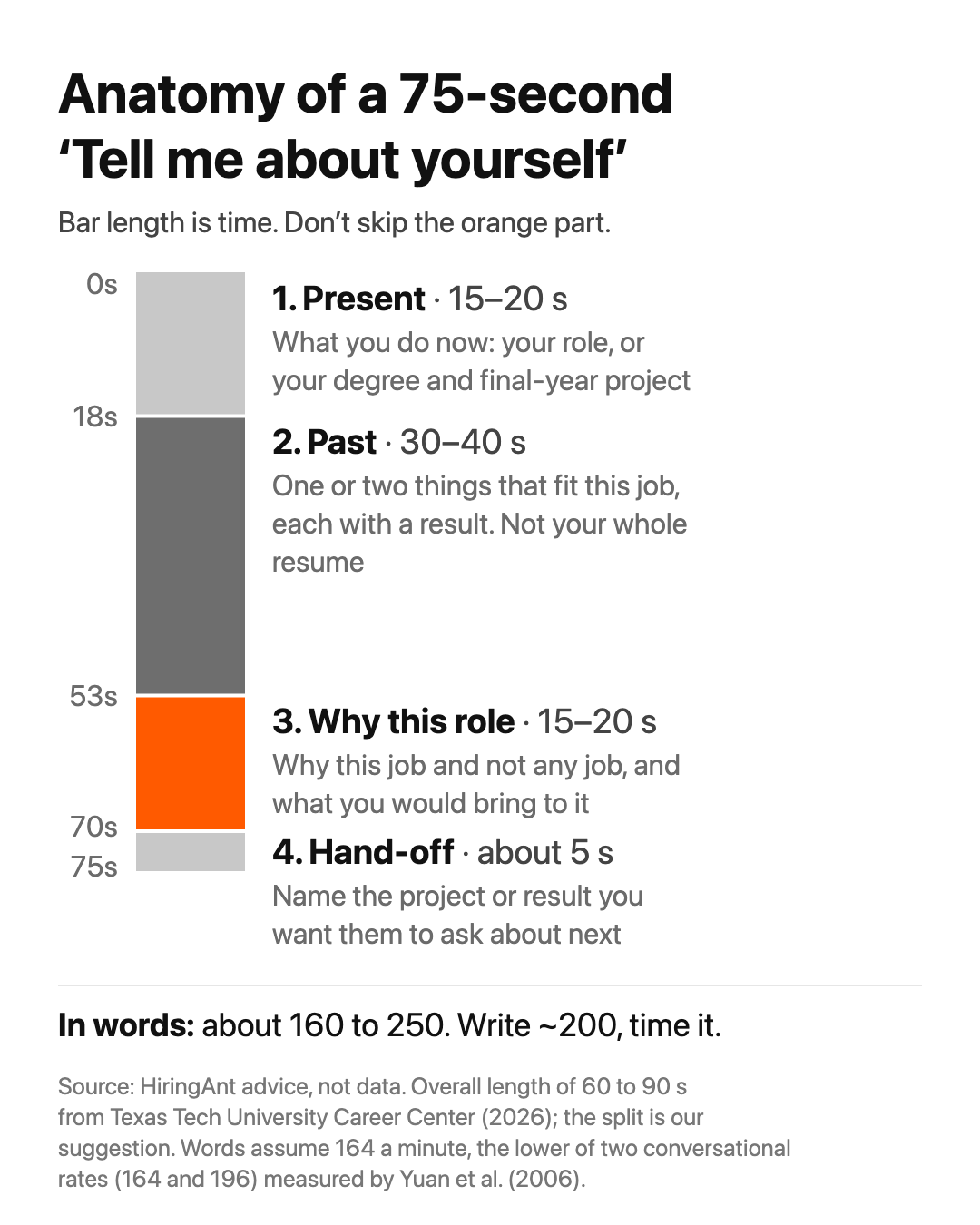
A suggested split for a 75-second answer. The overall length follows career-centre guidance; the split is our advice, not data.
Draft yours with this frame:
Present: "I'm a ___ at ___, where I ___." Fresher: "I'm in my final year of ___ at ___, and right now I'm ___."
Past: "Before this, I ___. The part most relevant to this role is ___, where I ___, and the result was ___."
Why this role: "I'm applying because ___, and I'd like to bring ___ to it."
Hand-off: "Happy to go deeper into ___ if that's useful."
Pick one or two pieces of work, each with a result. A two-line STAR story fits neatly here.
How long should "tell me about yourself" be?
60 to 90 seconds is the most common guidance. Texas Tech says about 60 to 90 seconds and tells students to time themselves (Texas Tech University Career Center, 2026). NDSU suggests 1 to 2 minutes (NDSU, 2023), and the University of Texas at Austin describes an "ideal two-minute response" (UT Austin, 2024). Our advice: 60 to 90 seconds, nearer 60 in a technical round.
In words: University of Pennsylvania researchers measured conversational English on recorded phone calls at 164 to 196 words a minute, depending on how pauses are counted (Yuan, Liberman and Cieri, 2006). At the slower rate, 60 seconds is about 160 words and 90 seconds about 250. Write about 200 words, read it aloud with a stopwatch, and cut until it fits.
Keep a 20-second version for when the interviewer says "briefly":
"I'm a final-year B.Tech Computer Science student from Bhopal. My main project is a hostel complaint-tracking app in Java and Spring Boot that students are using this semester. I'm applying for this trainee role because I want to start on real client work with proper training. Happy to tell you more about the app."
What should you not say in "tell me about yourself"?
A familiar weak answer in Indian interviews is a recital: name, hometown, parents' jobs, siblings, marks from Class 10 onwards, hobbies, strengths. Each line is already on your resume or unrelated to the job. Texas Tech is blunt: "Do not repeat your resume!"
Leave out:
- Family background. Texas Tech advises against volunteering family or marital status, because once you raise a topic the interviewer can ask more. That guide is written for US law, but the logic holds anywhere.
- Marks they already have. If you reached the interview through an eligibility cut-off, the panel has your percentages. Mention marks only if asked.
- Hobbies, unless one connects to the role.
- Adjectives without proof. "Hardworking and a quick learner" is what everyone says. One result says more.
- Salary or CTC. Expected pay is its own question, usually in the HR round. Our notice period and job switch guide covers it.
- A word-for-word script. Texas Tech and UT Austin both advise practising from key phrases so you sound natural.
The same B.Com fresher, before and after:
Before: "Good morning sir. My name is Rahul Verma. I am from Jabalpur, Madhya Pradesh. My father is a government employee and my mother is a homemaker. I have one younger sister who is in 12th. I did my 10th from Kendriya Vidyalaya with 86 percent and 12th with 78 percent, then B.Com. My hobbies are listening to music and playing cricket. My strengths are I am hardworking and a quick learner. My expected salary is 4 LPA."
After: "I've just finished my B.Com, and for the last six months I've been an accounts intern at a CA firm in Jabalpur, preparing GST return data in Tally for about fifteen small-business clients. The part I enjoy most is reconciliation. Last quarter I noticed one client's input tax credit didn't match their purchase register, and we corrected it before the return was filed. I'm applying for this accounts executive role because I'd like to work on one company's books in depth, instead of many in a hurry. Happy to explain the GST work in more detail."
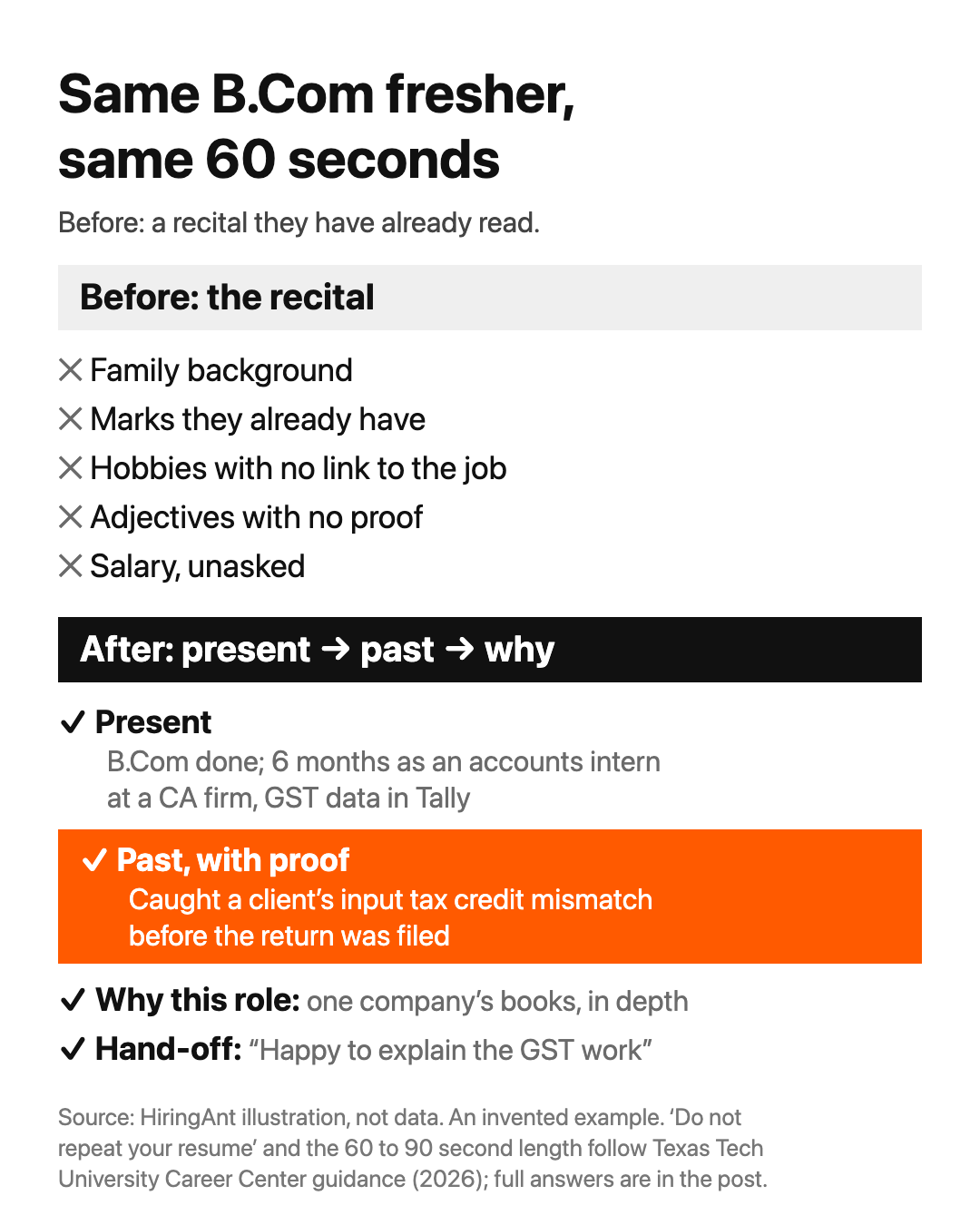
Same candidate, same 60 seconds. An invented example: the "after" swaps the recital for one piece of proof.
How is "tell me about yourself" different in HR, technical and AI interviews?
Keep the structure. Change the weight.
HR round. They are checking fit, motivation and communication. Give more time to why this company and role.
Technical round. Your answer often decides what they probe. Give your stack in one line, then spend the past on the one project you can defend in depth: what you built, one decision, the result. Never name a technology you cannot answer two questions on.
AI or one-way video interview. No nodding face tells you to stop. HireVue, a large video interview vendor, says most on-demand interviews ask for each answer in just a few minutes, and offer a practice question (HireVue). Finish with time to spare. A well-built AI interview works like a structured interview, where every answer is judged on the same rating scale (US OPM), so content matters most. HireVue, for instance, dropped facial analysis in March 2020 and said it primarily assesses the candidate's answers (as reported in February 2021) (SHRM, 2021). Vendors differ. Say your signposts out loud:
"Right now, I'm a QA engineer at a logistics company in Gurugram. Before that, I ... I'm applying for this role because ..."
Our AI interview preparation guide covers formats, setup and a one-week plan.
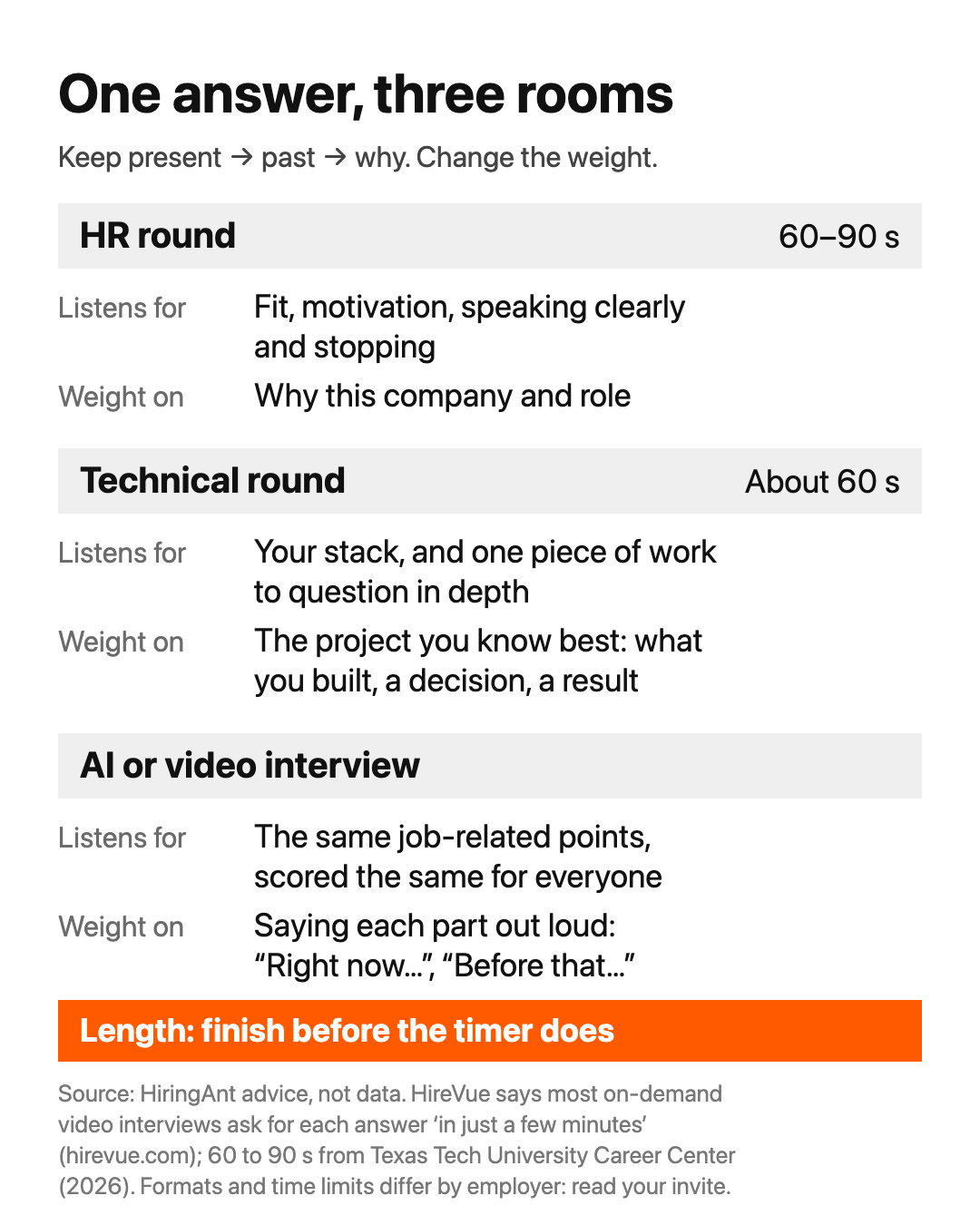
One structure, three settings. Formats and time limits differ by employer.
How should a fresher answer "tell me about yourself"?
Your present is your degree and best current work. Your past is one project, internship or responsibility, each with a result. Your why is what you want from a first job.
Sample answer: B.Tech fresher at a campus drive (170 words, about 60 to 70 seconds)
"Good morning. I'm Sneha, a final-year B.Tech Computer Science student from Bhopal. Right now I'm finishing my major project, a complaint-tracking app for our college hostels. I built the backend in Java with Spring Boot and MySQL, and students are using it this semester to raise and follow up on maintenance issues.
Before that, in my third-year summer, I did a six-week internship at a small software company in Indore. I was writing test cases for their billing module, and I found a rounding error in the GST calculation that they fixed before their next release. That's when I realised I enjoy finding problems as much as building things. I also solve problems regularly on LeetCode in Java, and this year I'm coordinating our department's coding club.
I'm applying for this trainee role because I want to start my career on real client projects with proper training behind me, and I'm open to relocating to any of your locations. I'd be happy to walk you through the hostel app."
Why it works: two concrete examples, no marks or family, a clear reason, and a hand-off. For the rest of the process, see our campus placement preparation guide.
How should an experienced professional answer "tell me about yourself"?
The present carries more weight: current role, scope and one result. Earlier jobs get a line each, and the move points towards something, not away from something.
Sample answer: backend developer, four years' experience, switching companies (160 words, about 60 to 70 seconds)
"I'm a backend developer with about four years of experience. For the last two years I've been at a payments company in Bengaluru, on our UPI collections service. My main area is reliability. Last year I led the redesign of our retry logic to a queue-based setup, and failed merchant callbacks came down by roughly forty percent after that.
I started at an IT services company in Pune, on a banking project, mostly Java and Oracle. That's where I learnt strict release processes and how to handle very demanding clients. I moved because I wanted to own a service end to end, not just pick up tickets.
Now I want to work at a larger scale and be closer to system design decisions. This role caught my attention because it's about building the payouts platform from the ground up, which connects directly to my reliability work. I can take you through the retry redesign if you'd like."
Why it works: scope and a result up front, a two-line past, a forward reason for moving. Be ready to explain any number you use.
How do you answer "tell me about yourself" when changing careers?
Lead with the bridge. Show the new field already appearing in your current work, then what you did about it, then what your old field adds to the new one. Do not apologise for the switch.
Sample answer: mechanical engineer moving into data analytics (160 words, about 60 to 70 seconds)
"I'm a mechanical engineer, and for the last three years I've been a production engineer at an auto-components plant near Pune. Over the past year, more and more of my work has been about data. I built a downtime dashboard for our machining line in Excel and Power BI, and it showed that two machines were causing most of our stoppages. After we fixed their changeover process, weekly downtime came down by around a fifth.
That project made me serious about analytics. Since then I've completed an online data analytics certificate, learnt SQL properly, and done two projects on public datasets, which are on my GitHub.
So I'm applying for this junior data analyst role because I want to do full time what I've enjoyed most in my current job. And since your clients are manufacturers, I think my plant background helps: I know how their data actually gets created on the shop floor. I'm happy to show you the downtime dashboard."
Why it works: the switch already started at work, and the old field becomes a strength.
Practise it out loud
Running long, slipping into the recital and forgetting the why only show up when you speak with a clock running.
HiringAnt Career Pro includes unlimited AI mock interviews: an AI interviewer asks, listens and follows up on what you said, then scores your answers and gives feedback. Anyone can try 2 free mock interviews without a plan, so you can rehearse your opener and the questions that follow it.
Your checklist
- Note the two skills the job description asks for most.
- Write one present line: current role, or degree and current work.
- Pick one or two past examples that match those skills, each with a result.
- Write one line on why this role, not any job.
- Add a hand-off naming the project you want them to ask about.
- Cut family, marks, hobbies, adjectives and salary.
- Say it aloud with a stopwatch and trim to 60 to 90 seconds.
- Practise from five key phrases, not a script.
- For an AI or video round, check the time limit first.
Frequently asked questions
Should I say my name when answering "tell me about yourself"?
A short greeting with your name is fine, especially at a campus drive or panel. Keep it to one line and move straight to the present.
Is "walk me through your resume" the same question?
Mostly. It invites a slightly more chronological answer, but the rule is the same: pick what fits this job, and do not read the resume line by line.
How do I explain a gap?
In one honest line, then move on: "I took a year to prepare for government exams, and I've since decided industry is where I want to build my career." Do not lead with it, and be ready for a follow-up.
Can I answer in Hindi?
Answer in the language the interview is held in. If the interviewer switches to Hindi and you are comfortable, follow them. The structure works in any language.
Sources
- Texas Tech University Career Center, "30-Second Elevator Pitch" and "How to Answer the 'Tell me about yourself' Interview Prompt", revised July 2026
- Brandeis University, Office of Graduate Affairs, "How to Answer: 'Tell Me About Yourself'"
- North Dakota State University Career and Advising Center, "Interview Essentials: Can you tell me about yourself?", 2023
- University of Texas at Austin, DiNitto Career Center, Steve Hicks School of Social Work, "Tell Me About Yourself", 2024
- Barrick, Swider and Stewart, "Initial evaluations in the interview: Relationships with subsequent interviewer evaluations and employment offers", Journal of Applied Psychology, 2010 (University of Iowa repository)
- British Psychological Society Research Digest, "Psychologists have looked at the importance of pre-interview chitchat", 2016, on Swider, Barrick and Harris, Journal of Applied Psychology, 2016
- Yuan, Liberman and Cieri, "Towards an Integrated Understanding of Speaking Rate in Conversation", Interspeech, 2006
- HireVue, "Candidate Interview Tips"
- SHRM, "HireVue Discontinues Facial Analysis Screening", February 2021
- US Office of Personnel Management, "Structured Interviews"
Avanish Patidar
Co-Founder & CTO HiringAnt
AI engineer, builder, and lifelong learner passionate about turning ambitious ideas into real products. I spend my time building AI agents, voice interviewers, and recruitment systems that help people discover better opportunities and companies hire exceptional talent. Driven by curiosity, innovatio
LinkedIn