Careers··14 min read
Will AI take my job? A role-by-role check for people working in India
Most research on AI and jobs measures which tasks AI can help with, not which jobs disappear. This guide explains what the evidence shows, which roles are most and least exposed, what early hiring data says about young workers, and gives you a 10-minute check you can run on your own job, with what to do next for each result.

Co-Founder & CTO HiringAnt
Probably not the whole job, at least not soon. The best research so far measures which tasks inside a job AI can help with, and almost every job has some. That is not the same as the job disappearing. So far, the clearest effect on actual employment is narrower: in US payroll data, fewer people aged 22 to 25 are being hired into the jobs most exposed to AI, while older workers in those same jobs have kept growing.
At HiringAnt we build AI tools that employers use to screen resumes and run first-round interviews, so we watch this question from the hiring side. What follows sticks to published evidence: what it measures, which roles are most and least exposed, what has actually happened to jobs, and a 10-minute check you can run on your own work.
Key takeaways
- "Exposure" studies measure tasks AI can do or help with, not jobs lost. Their own authors say so.
- Desk work that runs on information is most exposed: clerical and data entry, customer support, writing, translation, sales, programming and financial analysis.
- Hands-on work with people, machines or sites is least exposed: care, construction, repair, cooking, field work.
- In US data, the visible effect so far is slower hiring of young workers into exposed roles, not mass layoffs.
- Your exposure depends on how your week is split between tasks, so check your tasks, not your job title.
What do "AI exposure" studies actually measure?
They break each job into tasks and ask how many of those tasks AI can do or speed up. Four sources are worth knowing:
- Microsoft Research studied 200,000 anonymised conversations with Bing Copilot from US users in 2024 and scored each occupation on how much of its work AI was helping with (Tomlinson et al., 2025).
- Anthropic, which makes the Claude assistant, built an "observed exposure" measure from tasks that AI could in theory speed up and that people are actually using Claude for at work (Massenkoff and McCrory, 2026).
- The ILO scored nearly 30,000 tasks, starting from a survey of 1,640 workers and rounds of review by international experts, then applied the scores to occupations worldwide (Gmyrek et al., ILO, 2025).
- The US Bureau of Labor Statistics now combines five such measures, including Microsoft's and Anthropic's, into its own exposure categories (BLS, 2026).
All of them warn against reading exposure as job loss. BLS puts it plainly: "Exposure does not imply job loss." The ILO calls its numbers an upper limit, and concludes that jobs are more likely to be transformed than replaced, because nearly every occupation has tasks that need a person.
The Microsoft authors give an example: ATMs automated a core task of bank tellers, yet teller jobs rose, because banks opened more branches and tellers moved to relationship work. What happens to jobs, they conclude, "will depend on hard-to-predict business decisions".
There is also a gap between what AI could do and what people use it for. Anthropic notes that, on an earlier estimate of AI capability, 94% of tasks in computer and maths jobs could in theory be sped up by AI, yet Claude was being used for only 33% of them.
Which jobs are most exposed to AI?
The jobs at the top of every list share one thing: most of the day is spent creating, processing or passing on information.
- Microsoft's list is led by interpreters and translators, historians, writers and authors, sales representatives of services and customer service representatives (Tomlinson et al., 2025).
- Anthropic's list is led by computer programmers, with 75% of their tasks covered, then customer service representatives, then data entry keyers at 67% (Anthropic, 2026).
- The ILO's highest-exposure group is mostly clerical: data entry clerks, typists, accounting and bookkeeping clerks, payroll clerks, general office clerks and contact centre salespersons, along with financial analysts and web and multimedia developers (ILO, 2025).
In Indian job titles, that covers data entry operators, back-office and MIS executives, accounts and payroll executives, non-voice and voice process associates, telesales, content writers, translators, manual testers and junior developers.
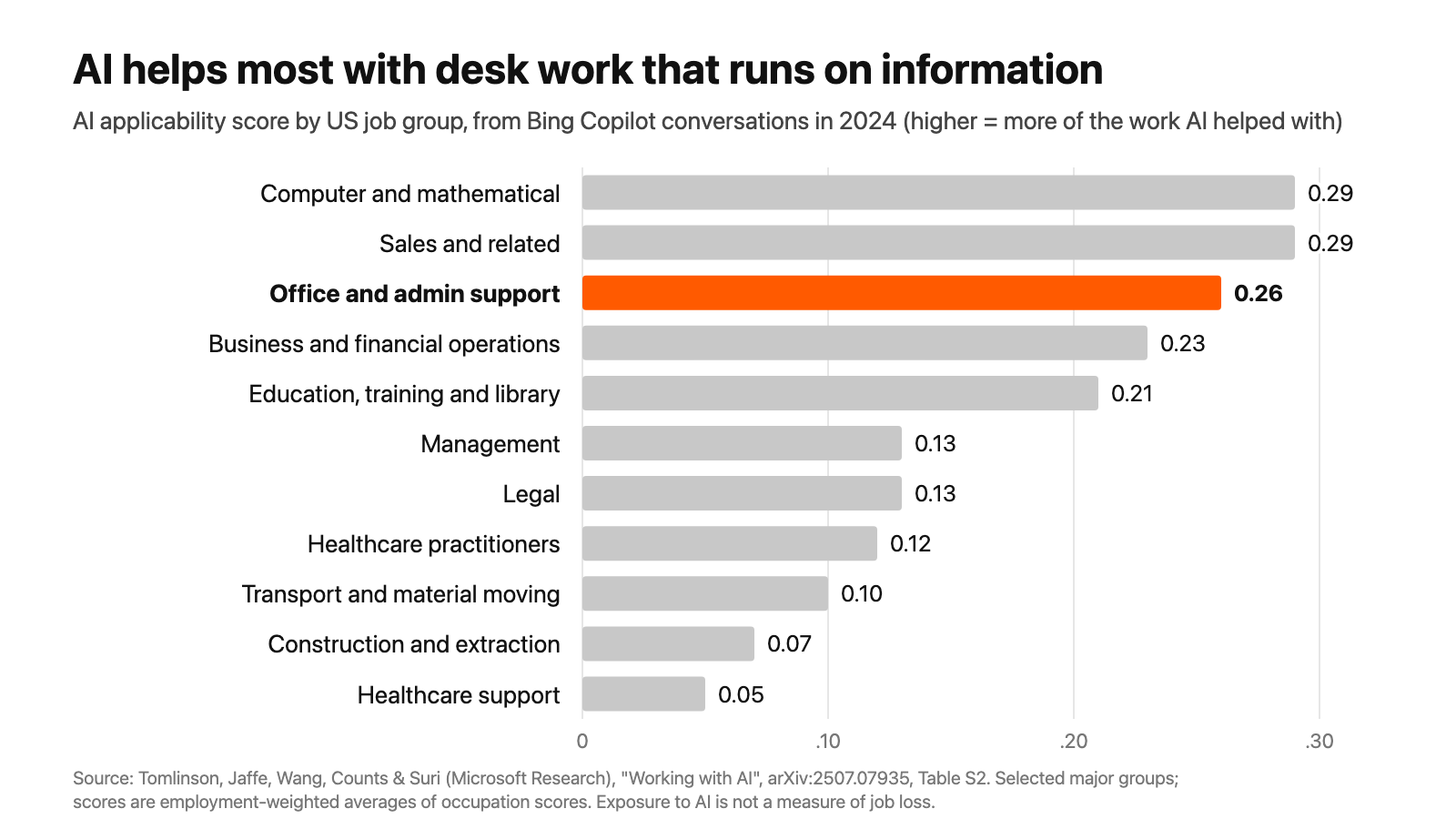
US data from Bing Copilot use in 2024. A higher score means more of the group's work activities were ones AI was helping with, not that the jobs are going.
Exposure is not only a low-wage issue: Anthropic's most exposed workers earned 47% more on average than workers with no exposure. Women are more exposed than men, as they are more often in clerical roles: 4.7% of women's jobs worldwide are in the ILO's highest-exposure group, against 2.4% of men's.
Which jobs are least exposed to AI?
Jobs where the work is physical, hands-on with people, or done on site. Microsoft's lowest-scoring groups were healthcare support (such as nursing assistants), farming and forestry, construction, and building cleaning and maintenance. Its lowest occupations included dredge operators, roofers, maids and housekeepers, dishwashers and orderlies. In Anthropic's data, 30% of workers had no measurable exposure at all, including cooks, motorcycle mechanics, lifeguards and bartenders.
In India, think nurses and ward staff, electricians, plumbers and technicians, delivery and driving, construction and site supervision, kitchen staff, beauticians, and field sales that happens face to face.
Low exposure is not a promise: BLS notes that a low score does not make a job safe from future technological change, such as robots, which these studies do not measure.
What has actually happened to jobs so far?
No broad job losses yet. Stanford's Digital Economy Lab tracks millions of US workers through ADP payroll data, and its August 2026 update finds "no evidence of widespread, economy-wide job displacement": from November 2022 to June 2026, total employment in its sample grew about 6% and the most exposed fifth of jobs about 4% (Brynjolfsson, Chandar and Chen, 2026). Anthropic, using US government survey data, finds no systematic rise in unemployment for highly exposed workers since late 2022.
But fewer young people are being hired into exposed jobs. In the same Stanford data, employment of 22 to 25 year olds in the most exposed jobs fell about 11% over that period, while their peers in less exposed jobs grew about 10%. Workers aged 35 to 49 in the most exposed jobs grew about 10%. The gap comes mainly from less hiring of young workers, not from more people being let go. Anthropic sees a similar but weaker signal: a 14% drop in the rate at which 22 to 25 year olds start jobs in exposed occupations, which it calls "just barely statistically significant".
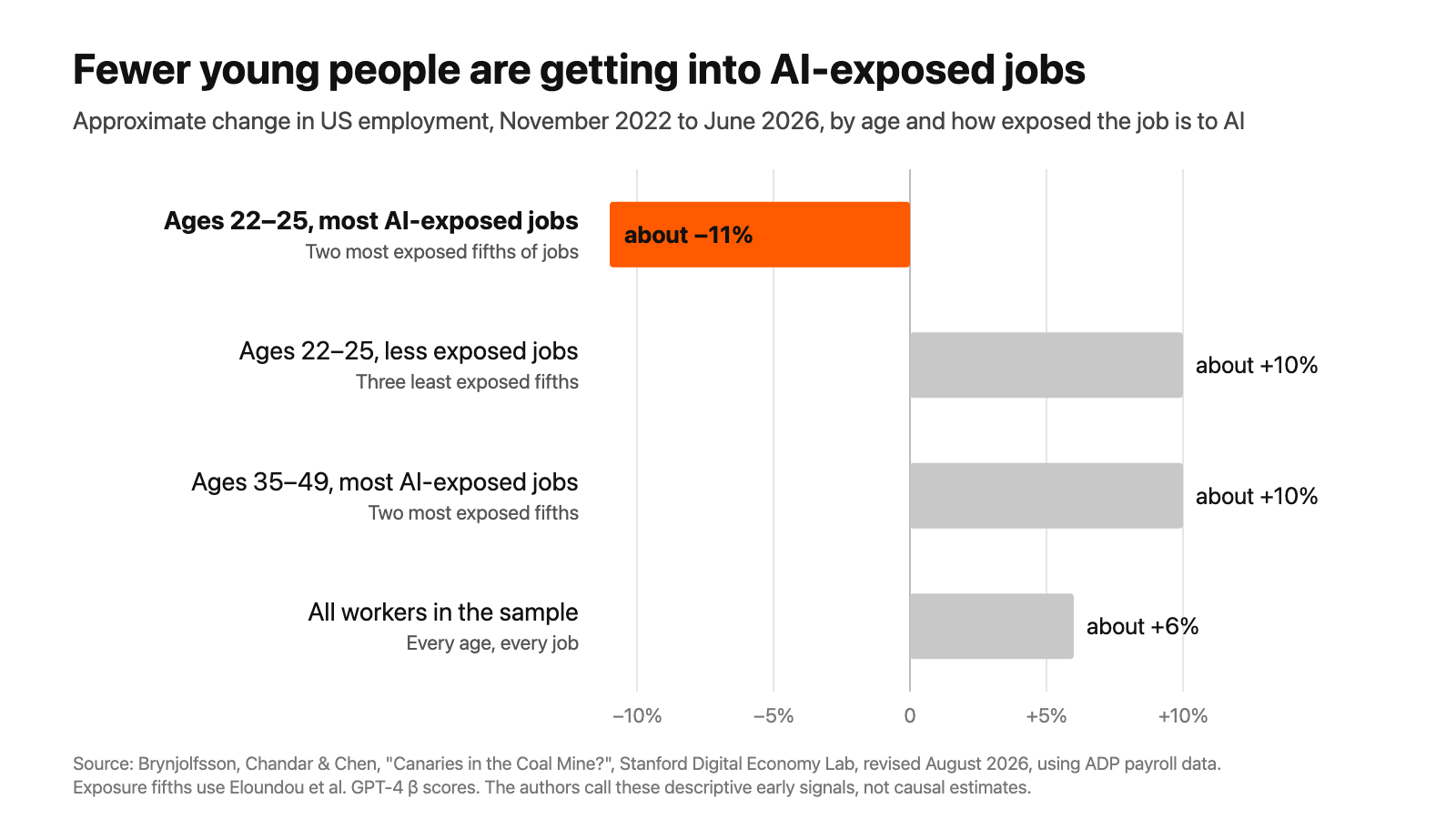
US payroll data. The authors describe these as early warning signs, not proof that AI caused the change.
One reading, for which the Stanford authors find suggestive evidence, is that AI substitutes most easily for "codified" knowledge, the kind you learn from books and courses. It does much less for tacit knowledge, the know-how you build on the job. Freshers mostly bring the first kind; experienced people have more of the second. The authors also caution that their results weaken when education is controlled for, and that some of the trends started before ChatGPT.
Forecasters expect a slow shift, not a cliff. In its 2025 to 2035 projections, BLS expects office and administrative support jobs in the US to fall 4.0%, the fastest decline of any major group, partly because of AI-powered automation, and sales jobs to fall 1.4%. Computer and mathematical jobs are still projected to grow 7.3%, and healthcare support 13.3%, against 3.5% for all jobs (BLS, 2026).
What does this mean for jobs in India?
Most hard job data comes from the US, so treat it as a signal, not a forecast for India.
The ILO finds exposure rises with a country's income: about 11% of jobs in low-income countries are in exposed occupations, against 34% in high-income countries, and about one in four jobs worldwide. Much of India's work is in farming, construction and other hands-on jobs, which these indexes score low. The exposed part sits in office jobs, and above all in IT services and BPO.
That is exactly where NITI Aayog's 2025 roadmap, prepared with NASSCOM and BCG, focuses (NITI Aayog, 2025). It sets out two scenarios rather than a forecast:
- Tech workforce: 7.5 to 8 million people in 2023, which could fall to 6 million by 2031 if India does little, or rise to 10 million if it acts on skills and new work.
- Customer service (CX): 2 to 2.5 million in 2023, which could fall to 1.8 million or rise to 3.1 million by 2031.
The report names QA engineers and first-line (L1) customer support as roles that may get automated, and expects their people to need to reskill. It estimates AI is lifting productivity across software development by 10 to 20%, more for simple applications, while infrastructure and network operations see under 10%.
If you are a fresher aiming for an entry-level IT, testing or BPO role, this is the part to take seriously. It does not mean those jobs vanish. It means the entry rung is likely to get narrower and more competitive.
The 10-minute self-check for your own job
Two "accounts executives" can have very different weeks, so check your tasks, not your title. Do it on paper, and keep client or company data out of any AI tool your employer has not approved.
- List 8 to 12 tasks from your last two weeks. Use your calendar, sent mail and tickets. Write real verbs: "reconcile vendor statements against the ledger", not "accounts".
- Put rough hours per week against each. Close enough is fine; the total should look like your real week.
- Mark each task with one letter: - A if AI does it well today: drafting, summarising, translating, formatting, standard replies, routine code, data entry from documents, first-pass research. - H if it needs a person for at least one of four reasons. Judgement: missing information, trade-offs, cases with no template. Relationships: trust, persuasion, negotiation, care. Physical presence: your hands, a site, a patient, a machine. Accountability: you sign off, you answer to an auditor, regulator or client. - M if it is mixed: AI could do a first draft, but you check, fix and finish.
- Test two of your A tasks for real. Use an AI assistant on made-up or public data. How close did it get, and how long did checking take? Move a task to M if the checking took real effort.
- Add up the hours in A, M and H as a share of your week.
Our rule of thumb, not a research finding: more than half your hours in A means highly exposed; mostly M, or A and M together a large share, means changing; mostly H means low exposure.
Worked example. Take Priya, an accounts executive at a mid-sized manufacturer in Pune, working about 40 hours a week:
- Entering vendor invoices: 10 hours, A
- Replying to routine vendor emails: 4 hours, A
- Bank reconciliation: 6 hours, M
- Pulling together GST return data: 5 hours, M
- Month-end reports: 4 hours, M
- Calling vendors about disputes: 5 hours, H (relationships)
- Explaining variances to the finance manager: 3 hours, H (judgement)
- Answering audit queries: 3 hours, H (accountability)
That is 14 hours A (35%), 15 hours M (about 38%) and 11 hours H (about 28%): a role that is changing, not disappearing. The ILO puts accounting and bookkeeping clerks in its highest-exposure group, which matches the A tasks. Priya's opportunity is in the M and H rows.

What should you do next, based on your result?
If your role is highly exposed (mostly A)
- Don't panic-quit. In the Stanford data, experienced workers in exposed jobs kept growing.
- Become the person who runs and checks the AI for those tasks. Volunteer for the pilot. Someone has to own the output.
- Shift your week towards H work. Ask for the vendor escalations, the client calls, the exceptions.
- Collect one before-and-after number, such as "cut invoice entry from 10 hours a week to 4". It belongs on your resume and in your next review.
- Name an adjacent role that uses what you know: data entry to MIS or reporting analyst; L1 support to L2, escalations, quality or customer success; manual tester to automation testing; content writer to editor or specialist writer; translator to localisation reviewer.
If your role is changing (mostly M)
Many office jobs sit here. Use AI on the A and M parts, keep a short log of the time it saves, and put that time into the H parts that make you hard to replace. Then make the change visible: turn it into one or two STAR stories you can tell in an appraisal or an interview.
If your exposure is low (mostly H)
Learn enough AI to handle your paperwork, such as notes, reports and quotations. Keep an eye on machines and robotics in your field, which these studies do not cover.
If you are a student or fresher
The rung that is thinning is the entry-level hire in exposed roles, so bring evidence that looks like experience: internships, real projects, a portfolio, work you can explain in detail. Make sure your resume reads cleanly in screening software, and use our campus placement guide to prepare for the drive. You don't need an expensive AI certificate. Showing how you used AI on a real project, and what you checked yourself, says more.
When to look outside
Consider a move if your role is mostly A and your employer is cutting its entry intake, or will not let you take on H work. Look while you are still employed: work out your notice period first, and prepare for the AI interviews many employers now use for first rounds. If you want help with the search, HiringAnt's AI Job Search ranks live roles against your resume, each with a reason, and is free to try.
How to read the next scary headline
- Tasks or jobs? "X% of jobs exposed" almost always means some tasks in those jobs, not X% of jobs ending.
- Which country and age group? Most job data is from the US, and the effect so far shows up mostly in hiring of young workers.
- Who says so? Look for a named study with its method, not a number with no source.
Your AI and jobs checklist
- List your real tasks and the hours each takes.
- Mark them A, M or H, and test two A tasks with an AI tool on safe data.
- Add up your A, M and H shares.
- Pick one A task to hand to AI and one H task to take on more of.
- Record one before-and-after number from using AI.
- Name one adjacent role you could grow into.
- Update your resume with that number and the skills behind it.
- Repeat the check every six months; tools and your job will both change.
Frequently asked questions
Will AI replace software engineers in India?
Not as a group, on current evidence. NITI Aayog estimates AI lifts software development productivity by 10 to 20%, and names QA as a role at risk, while BLS still projects US computer and maths jobs to grow 7.3% over the decade. The pressure is on entry-level and routine coding and testing, so juniors need to show more than syntax.
Is BPO or customer support safe from AI?
It is among the most exposed areas in every study above. NITI Aayog's scenarios for Indian customer service range from 1.8 million to 3.1 million jobs by 2031, from 2 to 2.5 million in 2023, depending on what the industry does. First-line query handling is most at risk; escalations, complex cases and relationship roles less so.
Which jobs are safest from AI?
On these measures, jobs that need hands-on physical work, care for people, or presence on a site: nursing and care work, skilled trades, repair, cooking, construction. BLS projects US healthcare support jobs to grow 13.3% over the decade. Safe from AI is not the same as safe from every change, though.
Should I learn AI to protect my job?
Learn to use it on your own tasks first. It is free, and it shows you exactly which parts of your work it handles well. A formal course makes sense when you are moving into a role that builds or runs AI systems.
The short answer
AI will change part of most office jobs, and the parts it changes are already visible. Whether yours shrinks or grows depends a lot on which tasks fill your week, and on what you do about it now. Spend the 10 minutes, mark your tasks, and move towards the work that needs a person.
Sources
- Tomlinson, Jaffe, Wang, Counts and Suri (Microsoft Research), "Working with AI: Measuring the Applicability of Generative AI to Occupations", arXiv:2507.07935, 2025
- Massenkoff and McCrory, Anthropic, "Labor market impacts of AI: A new measure and early evidence", 2026
- Gmyrek, Berg, Kamiński et al., "Generative AI and Jobs: A Refined Global Index of Occupational Exposure", ILO Working Paper 140, 2025
- Brynjolfsson, Chandar and Chen, "Canaries in the Coal Mine? Six Facts about the Recent Employment Effects of Artificial Intelligence", Stanford Digital Economy Lab, revised August 2026
- US Bureau of Labor Statistics, "Employment Projections: 2025–2035", 27 August 2026
- US Bureau of Labor Statistics, "AI exposure categories", 2026
- NITI Aayog, "Roadmap for Job Creation in the AI Economy", October 2025
Avanish Patidar
Co-Founder & CTO HiringAnt
AI engineer, builder, and lifelong learner passionate about turning ambitious ideas into real products. I spend my time building AI agents, voice interviewers, and recruitment systems that help people discover better opportunities and companies hire exceptional talent. Driven by curiosity, innovatio
LinkedIn